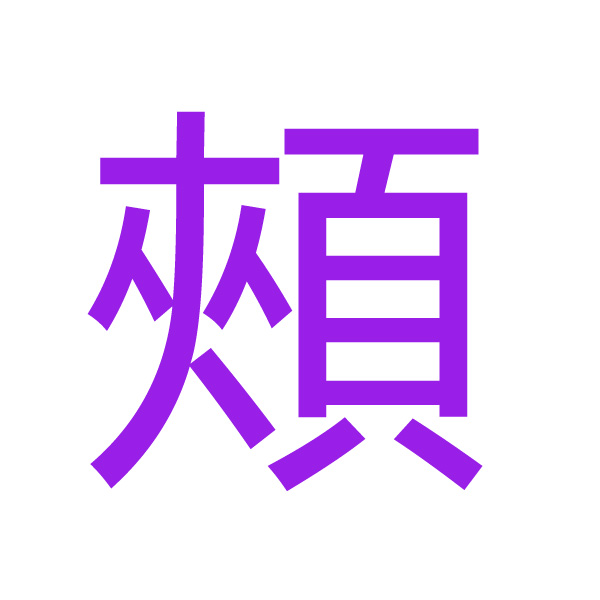
1. Meaning and Usage
The core meaning of the kanji 頰 is "cheek" (the part of the face). It refers to the soft area on the side of the face below the eye.
Important Note on Variants:
You have requested 頰, which is the kyūjitai (旧字体), or the traditional form of the kanji. In modern Japanese, the simplified shinjitai (新字体) 頬 is officially used. Both are read the same way and mean the same thing, but the stroke count and composition differ slightly. This analysis will focus on the traditional form 頰 as you requested.
Common Readings and Words:
ほお (hoho): The most common native Japanese reading for "cheek."
頰っぺた (hoppeta): Cheek (a more colloquial, slightly childish word).
きょう (kyō): The Sino-Japanese reading, rarely used alone but found in some compound words.
2. Correct Stroke Order (for 頰)
Writing the traditional form 頰 correctly is complex due to the number of strokes. The kanji is composed of the left radical 夾 and the right radical 頁.
Total Strokes: 16
Step-by-Step Breakdown:
Left Component: 夾 (Kyō - To Sandwich)
Stroke 1: Short horizontal stroke (横).
Stroke 2: Long horizontal stroke (横) below the first.
Stroke 3: Short vertical stroke (竖) in the center.
Stroke 4 & 5: The two "person" (人) radicals on either side. These are written from left to right, following the "left to right" rule.
Right Radical: 頁 (Ōgai - Page/Head)
Stroke 6: Short horizontal stroke (横) at the top.
Stroke 7: Short vertical stroke (竖).
Stroke 8: The next short vertical stroke.
Stroke 9: The horizontal折 (oritsu) that forms the "head" shape.
Stroke 10: Short left-falling stroke (撇) inside.
Stroke 11: Short vertical stroke (竖).
Stroke 12: Horizontal折 (oritsu) for the bottom.
Stroke 13: The left dot.
Stroke 14: The right dot.
Key Stroke Order Rules Applied:
Left to Right: The entire left component 夾 is written before the right radical 頁.
Top to Bottom: This rule is strictly followed within both components.
Center before Wings: The central part of 夾 is written before the two side "person" components.
3. Historical Origins and Etymology (The "Story" Behind the Kanji)
The history of 頰 is a brilliant example of an ideographic compound (会意文字 kaii moji), where the meaning is logically derived from its parts.
Let's break down its two components:
夾 (Kyō): This character means "to sandwich," "to press from both sides," or "to carry under the arm." It pictographically represents a large person or object (大) in the center, being held or pressed by two smaller figures (人、人) on either side. The core concept is "something flanked on both sides."
頁 (Ōgai): While it means "page" today, its original meaning was "head." The pictograph clearly shows a person with a large, emphasized head.
The Combined Meaning:
The character 頰 is a perfect logical construction:
"The parts of the head (頁) that are pressed/sandwiched on both sides (夾)."
Imagine your head. What are the two prominent, soft areas that are naturally "sandwiched" between your central features (nose, mouth) and your ears? They are your cheeks.
This kanji doesn't just mean "cheek"; it brilliantly describes the cheek's anatomical location and quality. The 夾 component conveys the sense of the cheeks being a pair of fleshy areas that flank the center of the face.
4. Example Sentences
Here are some example sentences showing the use of 頰.
As "Cheek" (ほお):
Romaji: Kanojo wa hoho o akarameta.
English: She blushed (reddened her cheeks).
彼女は頰を赤らめた。
In a Descriptive Context:
Romaji: Kodomo no yawarakai hoho o nadeta.
English: I stroked the child's soft cheek.
子供の柔らかい頰を撫でた。
Using the Colloquial Form:
Romaji: Hoppeta ni kisu o shita.
English: I kissed her on the cheek.
頰っぺたにキスをした。
Summary
Meaning: Cheek.
Writing (頰): 16 strokes. A complex character where you write the left "sandwich" component 夾 first, then the right "head" radical 頁.
Origin: An ideographic compound that is a masterclass in logical description. It combines 夾 (to sandwich/press from both sides) with 頁 (head) to create the meaning "the parts of the head that are flanked on both sides," which is a perfect description of the cheeks. The modern simplified form is 頬.