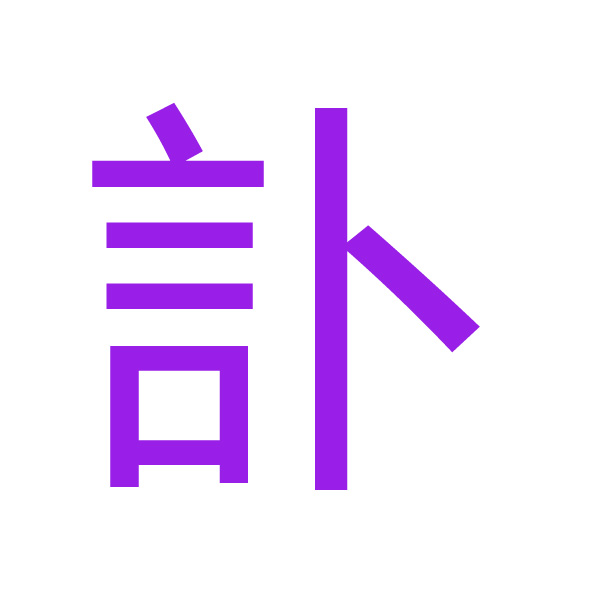
1. Meaning and Usage
The core meaning of the kanji 訃 is "obituary," "death notice," or "news of a death." It is a highly specific character used almost exclusively in contexts related to announcing that someone has died.
Common Readings and Words:
ふ (fu): The Sino-Japanese reading, used in the primary word associated with this kanji.
訃報 (fuhō): News of a death, an obituary notice. (訃-death notice + 報-report)
訃音 (fuin): News of a death (a slightly more literary term, similar to 訃報).
This kanji is almost never used alone in modern Japanese and is almost always seen in the compound 訃報 (fuhō).
2. Correct Stroke Order
Writing 訃 correctly is straightforward. The kanji is composed of the left radical 言 (gen) and the right component 卜 (boku).
Total Strokes: 9
Step-by-Step Breakdown:
Left Radical: 言 (Gon-ben - To Speak)
Stroke 1: Dot on the top (点).
Stroke 2: Short horizontal stroke (横) below the dot.
Stroke 3: Second short horizontal stroke (横).
Stroke 4: Long horizontal stroke (横) at the bottom.
Stroke 5: Short vertical stroke (竖) in the center. Note: The "speech" radical is written completely before moving to the right side.
Right Component: 卜 (Boku - Divination)
Stroke 6: Short vertical stroke (竖) from top to bottom.
Stroke 7: A short diagonal stroke that touches the vertical, going from the center to the lower-right. This is a right-falling stroke (捺).
Key Stroke Order Rules Applied:
Left to Right: The entire left radical 言 is written before the right component 卜.
Top to Bottom: This rule governs the order within the 言 component.
3. Historical Origins and Etymology (The "Story" Behind the Kanji)
The history of 訃 is a great example of a 形声文字 (keisei moji) or phonetic-ideographic compound, where the meaning is perfectly clear from its components.
Let's break down its two parts:
Semantic Component (Meaning): 言 (Gen - Word/Speech)
This radical means "word," "speech," or "to say." Its presence immediately tells us that the character is related to communication, news, or a message.
Phonetic Component (Sound): 卜 (Boku - Divination)
This component provided the ancient Chinese pronunciation. However, its meaning is also highly significant. The character 卜 originally depicted the cracks that appeared on a turtle shell or animal bone when heated for divination in ancient China. These cracks were interpreted as omens or messages from the gods or ancestors about the future.
The Combined Meaning:
The character 訃 is constructed in a very logical and poignant way:
"A message (言) of an omen (卜)."
In ancient times, news of a death was not just sad information; it was often seen as a fateful, ominous event—a message that carried the weight of a divine omen. The component 卜 captures this sense of a sudden, fateful, and often negative announcement.
The character essentially means "to report news of a death." It is the act of verbally conveying the ominous, sorrowful message that someone has passed away. This is why it is almost always found in the word 訃報 (fuhō), which literally means a "report of a death notice."
4. Example Sentences
Given its specific meaning, 訃 is only used in formal or news contexts related to death announcements.
In a News Headline:
Romaji: Sakka no fuhō ga tsutaerareta.
English: News of the author's death was reported.
作家の訃報が伝えられた。
In a Formal Announcement:
Romaji: Heisha shachō no fuhō ni sai shi, tsutsushinde oshirase mōshiagemasu.
English: We respectfully announce the sad news of our company president's passing.
弊社社長の訃報に際し、謹んでお知らせ申し上げます。
Expressing Condolences:
Romaji: Go-fuhō o itadaki, tsutsushinde okuyami mōshiagemasu.
English: Upon receiving the news of the bereavement, we wish to express our deepest condolences.
ご訃報をいただき、謹んでお悔み申し上げます。
Summary
Meaning: Obituary, news of a death.
Writing: 9 strokes. Write the left "speech" radical 言 first, then the right "divination" component 卜.
Origin: A phonetic-ideographic compound. It combines 言 (speech/word), representing the announcement, with 卜 (divination/omen), which provided the sound and the conceptual idea of a fateful, ominous message. Together, they create the powerful meaning of "announcing the ominous news of a death."