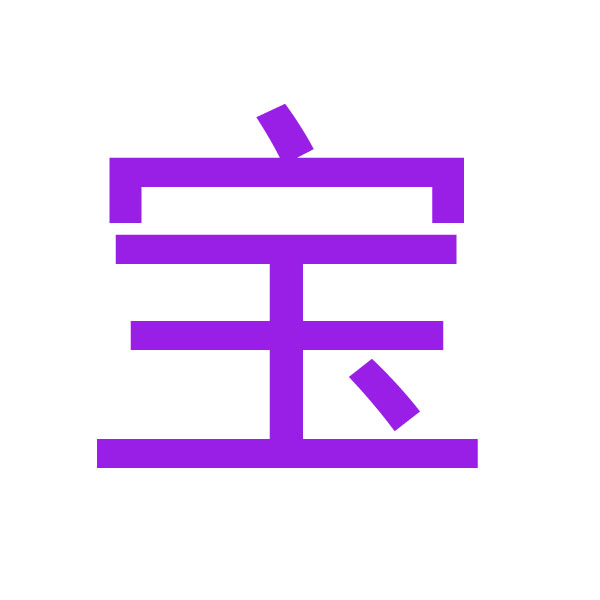
1. Kanji Breakdown: 寶 (Traditional) / 宝 (Simplified)
This kanji represents something of immense value and cherished importance.
Meaning: Treasure, precious thing, treasure-house.
Reading:
Onyomi (Sino-Japanese reading): ホウ (hou)
Kunyomi (Native Japanese reading): たから (takara)
The kanji is a compound ideograph (会意文字). It consists of two parts:
Top (宀): This is the "roof" radical (うかんむり), representing a house or a building.
Bottom (玉): This means "jewel," "gem," or "ball."
The elegant and literal meaning is "jewels under a roof"—the valuable possessions stored safely inside a house. This naturally evolved to mean "treasure" in a broader sense.
2. Stroke Order and Writing
Learning the correct stroke order is crucial for balanced and beautiful kanji. "宝" has 8 strokes.
Here is the stroke order diagram and explanation:
Total Strokes: 8
Start with the top radical "宀" (roof radical):
Then, write the bottom part "玉":
Key Writing Tips:
Write from top to bottom.
The roof radical "宀" should be wide enough to "shelter" the jewel below.
The bottom part "玉" should be centered under the roof. The final dot is essential to distinguish it from the kanji "王" (king).
The overall character should feel stable and protected.
3. Vocabulary and Example Sentences
Here are some common words using "宝" and how to use them in sentences.
Vocabulary
宝 (たから, takara)
Meaning: Treasure.
Example: この古い地図は宝の在処を示している。
Romaji: Kono furui chizu wa takara no arika o shimeshite iru.
English: This old map shows the location of the treasure.
宝物 (たからもの, takaramono)
Meaning: Treasure, prized possession (can be both material and abstract).
Example: 家族の写真は私の宝物です。
Romaji: Kazoku no shashin wa watashi no takaramono desu.
English: My family photos are my treasured possessions.
宝くじ (たからくじ, takarakuji)
Meaning: Lottery.
Example: 宝くじが当たったら何をしますか。
Romaji: Takarakuji ga atattara nani o shimasu ka.
English: What would you do if you won the lottery?
国宝 (こくほう, kokuhou)
Meaning: National treasure.
Example: その寺には多くの国宝が収められている。
Romaji: Sono tera ni wa ōku no kokuhou ga osamerarete iru.
English: Many national treasures are housed in that temple.
貴重品 (きちょうひん, kichouhin)
Meaning: Valuables, precious items.
Example: 貴重品は各自で管理してください。
Romaji: Kichouhin wa kakuji de kanri shite kudasai.
English: Please keep your valuables with you at all times.
宝箱 (たからばこ, takarabako)
Meaning: Treasure chest, treasure box.
例文: 海賊が宝箱を埋めた。
Romaji: Kaizoku ga takarabako o umeta.
English: The pirates buried a treasure chest.
Summary
Kanji: 宝
Core Meaning: Treasure.
Readings: On'yomi ホウ (hou), Kun'yomi たから (takara)
Stroke Order: 8 strokes. Remember it's composed of 宀 (top - roof) and 玉 (bottom - jewel). Practice writing it step-by-step to master its precious form.
This kanji is essential for talking about things of great value, from literal treasure to cherished personal items. By mastering its stroke order and vocabulary, you will be able to correctly write and use this wonderful character.