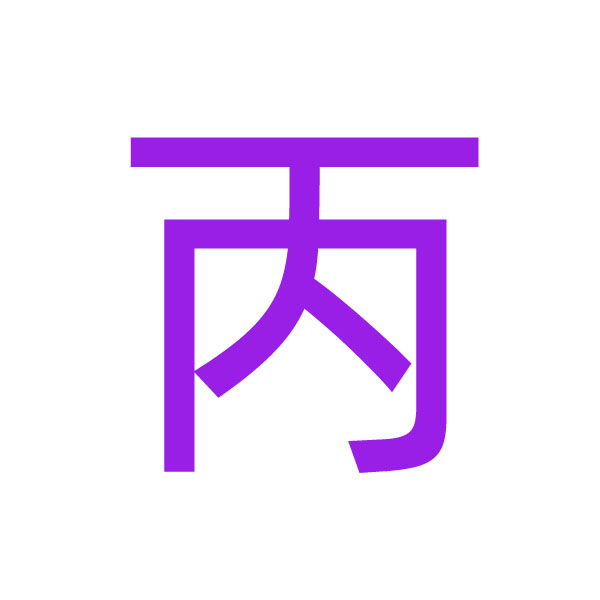
1. Kanji Breakdown: 丙
This kanji is one of the ten "Celestial Stems" and carries meanings related to order, fire, and rank.
Meaning: Third; fire element (in Chinese philosophy); C-grade.
Reading:
Onyomi (Sino-Japanese reading): ヘイ (hei)
Kunyomi (Native Japanese reading): ひのえ (hinoe)
The kanji is one of the Ten Heavenly Stems (十干, jikkan), an ancient Chinese cyclical system used for counting, calendars, and time. "丙" is the third in this sequence. In the Five Elements (五行, gogyō) philosophy, it is associated with "Fire" and represents the "Yang Fire" (bright, strong fire). Its shape is thought to be pictographic, possibly representing the "sprout of a plant", symbolizing the third stage of growth.
2. Stroke Order and Writing
Learning the correct stroke order is crucial for balanced and beautiful kanji. "丙" has 5 strokes.
Here is the stroke order diagram and explanation:
Total Strokes: 5
The first horizontal stroke. (From left to right)
The left vertical stroke. (From top to bottom)
The right vertical stroke. (From top to bottom)
The left-falling stroke inside. (A diagonal from the center-left)
The right-falling stroke inside. (A diagonal from the center-right)
Key Writing Tips:
Write from top to bottom, outside to inside.
The outer frame should be a wide, stable rectangle.
The two inner diagonal strokes should be balanced and centered.
The overall character should feel solid and well-proportioned.
3. Vocabulary and Example Sentences
Here are some common words using "丙" and how to use them in sentences.
Vocabulary
丙 (へい, hei)
Meaning: Third; C-grade (in ratings).
Example: 成績は丙だった。
Romaji: Seiseki wa hei datta.
English: My grade was a "C".
甲乙丙 (こうおつへい, kō otsu hei)
Meaning: A, B, and C; first, second, and third. (This is the Japanese equivalent of "A, B, C" for ranking or listing things).
Example: 意見を甲乙丙に分ける。
Romaji: Iken o kō otsu hei ni wakeru.
English: To divide the opinions into A, B, and C.
丙午 (ひのえうま, hinoe uma)
Meaning: The 43rd year in the 60-year Jikkan Junishi cycle. In Japanese folklore, women born in this year are believed to be strong-willed and ill-fated for marriage, leading to lower birth rates in those years historically.
Example: 1966年は丙午でした。
Romaji: Sen kyūhyaku rokujū roku nen wa hinoe uma deshita.
English: The year 1966 was the Year of the Fire Horse.
丙種 (へいしゅ, heishu)
Meaning: C-type, third class.
Example: 危険物取扱者丙種の免状を持っている。
Romaji: Kikenbutsu toriatsukaisha heishu no menjō o motte iru.
English: I have a Class C Hazardous Materials Handler license.
Summary
Kanji: 丙
Core Meaning: Third; Fire (Yang); C-grade.
Readings: On'yomi ヘイ (hei), Kun'yomi ひのえ (hinoe)
Stroke Order: 5 strokes. Focus on the stable outer frame and the balanced inner strokes.
This kanji is less common in everyday vocabulary but is crucial for understanding traditional East Asian systems of counting, elements, and calendars. By mastering its stroke order and usage, you will be able to correctly write and understand this classical character.