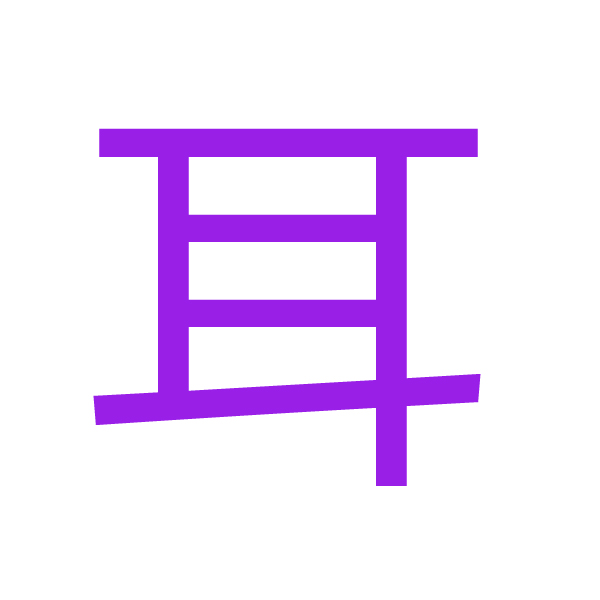
The Kanji: 耳 (Mimi/Ji) - The "Ear" Kanji
The kanji "耳" is a direct pictogram representing the "ear." It is one of the fundamental body part kanji, and its meaning extends to anything ear-shaped or related to hearing.
1. Meaning and Usage
Core Meanings: Ear; hearing; edge (of a pot, cup, etc.).
Readings:
Kun'yomi (Japanese reading): みみ (mimi)
On'yomi (Chinese reading): ジ (ji)
Common Words and Compounds:
耳 (みみ / mimi) - Ear
耳鼻科 (じびか / jibika) - Otolaryngology (Ear-Nose-Throat department)
内耳 (ないじ / naiji) - Inner ear
耳鳴り (みみなり / miminari) - Tinnitus (Ear ringing)
2. Writing and Stroke Order: Capturing the Form of an Ear
The correct kanji writing for "耳" is relatively simple but requires attention to proportion and stroke order to achieve its characteristic shape.
Stroke Order:
Stroke 1: A long horizontal stroke from left to right. This is the top line.
Stroke 2: A short left vertical stroke, attached to the left end of the first stroke.
Stroke 3: A long right vertical stroke, attached to the right end of the first stroke and extending down. (Strokes 1-3 form a hollow "U" shape).
Stroke 4: A short horizontal stroke inside the top half, from left to right.
Stroke 5: A second short horizontal stroke below the first, parallel to it.
Stroke 6: A long horizontal stroke at the bottom, connecting the two verticals and closing the box.
Significance of Correct Kanji Writing:
Proportions: The character should be taller than it is wide, accurately reflecting the vertical shape of a human ear. The two internal horizontal strokes should be evenly spaced and clearly visible.
Stability: The final, long horizontal stroke (6) provides a stable base for the character, "grounding" it.
Radical Recognition: As the "ear" radical (みみへん), it appears in a limited number of other kanji, often related to hearing or the ear itself (e.g., 聞 - to hear; to ask, 聴 - to listen attentively).
3. Historical Origin and Evolution
The history of "耳" is a classic and clear example of a pictogram that has remained recognizable for over 3,000 years.
Oracle Bone Script (甲骨文字):
The earliest form was a highly detailed and realistic side-view pictogram of a human ear. It masterfully captured the complex curves, the lobe, and the auditory canal of the outer ear. It was unmistakably an ear.
Bronze Script (金文) & Seal Script (篆書):
The form became more stylized and linear. The intricate curves were simplified into broader lines, but the overall silhouette of the ear remained perfectly clear. The characteristic shape of the lobe and the upper curves were emphasized.
Modern Form (楷書):
The modern "耳" is a clean and rectangular abstraction of its ancient form. The original curved outline has been squared off into a box with internal strokes, a process common in the standardization of kanji for easy writing. However, the general vertical outline and the internal details (which can be seen as representing the internal folds of the ear) still echo the original pictogram.
Cultural and Conceptual Connection:
In Japanese language and culture, the "ear" is synonymous with the act of listening and receiving information.
Receptiveness: Having an "ear that stands up" (耳が立つ, mimi ga tatsu) means to listen attentively. An "early ear" (耳が早い, mimi ga hayai) means to be quick to hear news (i.e., to have good sources of information).
The Handle: The extended meaning of "edge" or "handle" (like the "ears" of a ceramic pot) comes from the physical resemblance to a human ear.
The Radical for Hearing: As a radical, it is most prominently featured in the kanji 聞 (to hear; to ask), where it signifies the primary sense involved in the action.
Summary
The kanji "耳" is a character with a form that is deeply rooted in its original pictorial representation. It began as a remarkably accurate drawing of a human ear and evolved through stylization into the efficient, symbolic character used today. Mastering its stroke order is a fundamental step in Japanese kanji writing, as it reinforces the pattern of creating an enclosure before adding internal details. When you learn how to write kanji like "耳," you are not just learning a word for a body part; you are learning a symbol that represents the gateway to sound, information, and understanding, a character whose form has been listening to the passage of time for millennia.