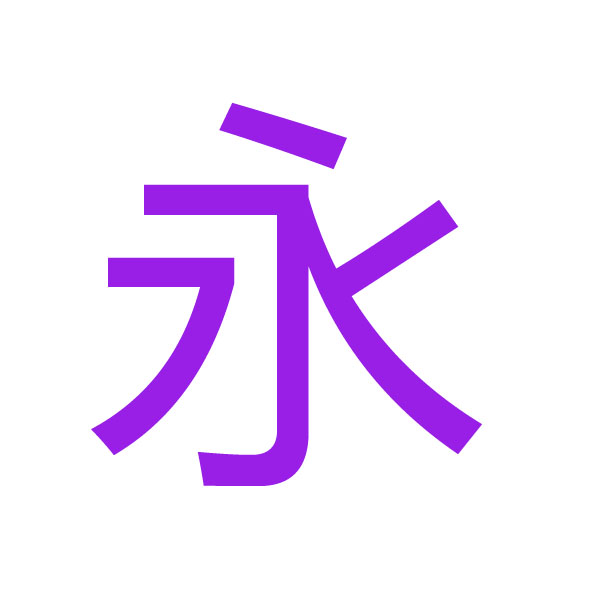
1. Kanji Breakdown: 永
This kanji represents a profound and beautiful concept of enduring continuity.
Meaning: Eternity, permanence, perpetuity, long-lasting.
Reading:
Onyomi (Sino-Japanese reading): エイ (ei)
Kunyomi (Native Japanese reading): なが(い) (naga(i))
The etymology of "永" is pictographic. Its original form depicted "flowing water" (a modified form of 泳 - to swim). The image of a river flowing endlessly into the distance came to symbolize something that continues forever without ceasing—eternity.
2. Stroke Order and Writing
Learning the correct stroke order is crucial for balanced and beautiful kanji, especially for one like "永" which is fundamental to Japanese calligraphy. It has 5 strokes.
Here is the stroke order diagram and explanation:
Total Strokes: 5
The left-falling dot. (A short stroke from top-right to bottom-left)
The horizontal stroke. (From left to right)
The central vertical hook. (This is the key stroke, going down and hooking up)
The left-falling stroke. (A long diagonal from the center)
The right-falling stroke. (A long diagonal that balances the previous stroke)
Key Writing Tips:
The stroke order is essential for achieving the correct balance. This character is often used to practice the eight basic strokes in calligraphy (永字八法).
The central vertical hook (stroke 3) is the backbone of the character.
The final two diagonal strokes (4 & 5) should be symmetrical and flowing, giving the character a sense of dynamic stability.
3. Vocabulary and Example Sentences
Here are some common words using "永" and how to use them in sentences.
Vocabulary
永遠 (えいえん, eien)
Meaning: Eternity, perpetuity, forever.
Example: あなたを永遠に愛します。
Romaji: Anata o eien ni ai shimasu.
English: I will love you forever.
永久 (えいきゅう, eikyuu)
Meaning: Permanent, eternal, everlasting.
Example: このインクは永久に消えない。
Romaji: Kono inku wa eikyuu ni kienai.
English: This ink is permanent (will not disappear forever).
永続 (えいぞく, eizoku)
Meaning: Lasting a long time, continuation, permanence.
Example: 平和な状態が永続することを願う。
Romaji: Heiwa na jōtai ga eizoku suru koto o negau.
English: I hope the state of peace will continue permanently.
永眠 (えいみん, eimin)
Meaning: Eternal sleep; a euphemism for death.
Example: 彼は安らかに永眠した。
Romaji: Kare wa yasuraka ni eimin shita.
English: He passed away (entered eternal sleep) peacefully.
永住 (えいじゅう, eijuu)
Meaning: Permanent residence.
Example: 日本で永住権を取得した。
Romaji: Nihon de eijuu-ken o shutoku shita.
English: I obtained permanent residency in Japan.
Summary
Kanji: 永
Core Meaning: Eternity, Permanence, Perpetuity.
Readings: On'yomi エイ (ei), Kun'yomi ながい (nagai)
Stroke Order: 5 strokes. This is a foundational character for learning proper stroke technique and balance.
This kanji is essential for expressing concepts of time, endurance, and profound continuity. By mastering its elegant and flowing stroke order, you will be able to correctly write and use this deeply meaningful character.