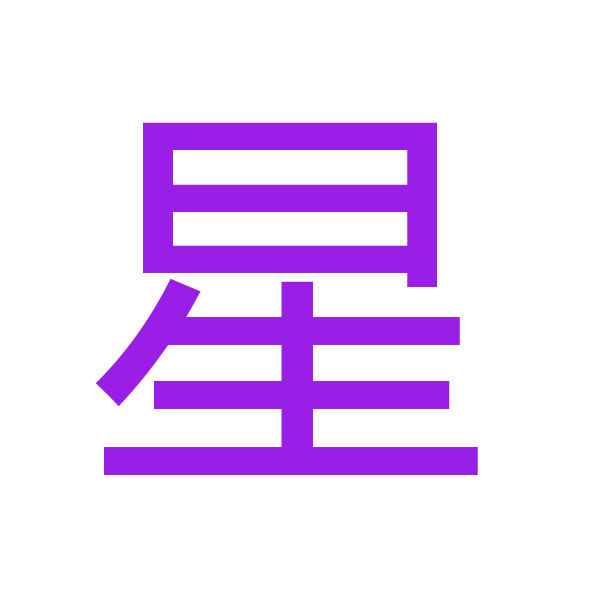
1. Kanji Breakdown: 星
This kanji represents a beautiful and fundamental celestial body.
Meaning: Star.
Reading:
Onyomi (Sino-Japanese reading): セイ (sei), ショウ (shou)
Kunyomi (Native Japanese reading): ほし (hoshi)
The kanji is a compound ideograph (会意文字). It consists of two parts:
Top (日): This means "sun" or "day," representing a celestial body that gives light.
Bottom (生): This means "life," "birth," or "to grow."
A classical interpretation is that stars were seen as "living suns" or "suns that are born" scattered across the sky. The character beautifully combines the ideas of celestial light and generative life.
2. Stroke Order and Writing
Learning the correct stroke order is crucial for balanced and beautiful kanji. "星" has 9 strokes.
Here is the stroke order diagram and explanation:
Total Strokes: 9
Start with the top part "日":
Then, write the bottom part "生":
Key Writing Tips:
Write from top to bottom.
The top "日" should be slightly flatter and wider.
The bottom "生" should be taller, with the vertical stroke acting as the central spine.
The final horizontal stroke of "生" should be the longest, providing a stable base for the character.
3. Vocabulary and Example Sentences
Here are some common words using "星" and how to use them in sentences.
Vocabulary
星 (ほし, hoshi)
Meaning: Star.
Example: 今夜は星がとてもきれいだ。
Romaji: Konya wa hoshi ga totemo kirei da.
English: The stars are very beautiful tonight.
星座 (せいざ, seiza)
Meaning: Constellation.
Example: オリオン座は冬の星座です。
Romaji: Orion-za wa fuyu no seiza desu.
English: The Orion constellation is a winter constellation.
流れ星 (ながれぼし, nagareboshi)
Meaning: Shooting star, meteor.
Example: 流れ星に願い事をした。
Romaji: Nagareboshi ni negai goto o shita.
English: I made a wish upon a shooting star.
明星 (みょうじょう, myoujou)
Meaning: Bright star, Venus (the morning/evening star).
Example: 明け方の東の空に明星が見える。
Romaji: Akegata no higashi no sora ni myoujou ga mieru.
English: The bright star (Venus) can be seen in the eastern sky at dawn.
星占い (ほしうらない, hoshiuranai)
Meaning: Horoscope, astrology.
Example: 今日の星占いをチェックする。
Romaji: Kyō no hoshiuranai o chekku suru.
English: I check today's horoscope.
Summary
Kanji: 星
Core Meaning: Star.
Readings: On'yomi セイ (sei), Kun'yomi ほし (hoshi)
Stroke Order: 9 strokes. Remember it's composed of 日 (top - sun) and 生 (bottom - life). Practice writing it step-by-step to master its celestial form.
This kanji is essential for talking about astronomy, the night sky, and related concepts. By mastering its stroke order and vocabulary, you will be able to correctly write and use this beautiful character.