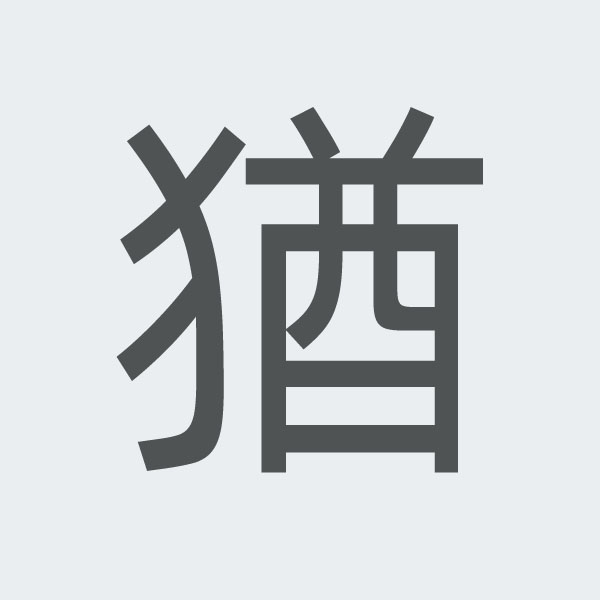
1. Kanji Breakdown: 猶
Meaning: Hesitate; still, yet, furthermore; just as, like.
Reading:
Onyomi (Sino-Japanese reading): ユウ (yuu)
Kunyomi (Native Japanese reading): なお (nao)
The kanji is a phono-semantic compound (形声文字). It consists of two parts:
Left (犭): The "beast" or "dog" radical (けものへん).
Right (酋): This component, originally depicting a fermented alcoholic vessel, provides the sound ("yuu").
The core meaning originates from the behavior of a "hesitant dog." It was said that when a dog is frightened or uncertain, it hesitates to move forward, looking around warily. This imagery of cautious indecision evolved into the meanings of "hesitate" and "still/yet" (implying a delayed action). The meaning "furthermore" is an extension of "still," and "just as" comes from classical comparative usage.
2. Stroke Order and Writing (12 Strokes)
Correct stroke order is essential for balanced and legible kanji.
Stroke Order Diagram:
Start with the left radical "犭" (beast radical):
Then, write the right part "酋":
Key Writing Tips:
Write from left to right, top to bottom.
The left radical "犭" is narrow.
The right part "酋" is more complex. Pay attention to the "八" shape on top and the "酉" base.
The overall character should be balanced.
3. Core Meanings & Example Sentences
Here are the primary meanings of "猶" with common vocabulary and practical example sentences.
A. Still / Yet / Furthermore (なお)
なお (nao)
Meaning: Still, yet, furthermore, in addition (conjunction/adverb).
Example: 説明書を読みました。なお、詳細は弊社サイトでご確認ください。
English: I read the manual. Furthermore, please check our website for details.
猶予 (ゆうよ, yūyo)
Meaning: Postponement, deferment, grace period; hesitation.
Example: レポートの提出に3日間の猶予が与えられた。
English: I was given a 3-day grace period to submit the report.
B. Hesitate (ためらう)
猶予 (ゆうよ, yūyo)
Meaning: Hesitation (this meaning is also covered by the same word).
Example: 一瞬の猶予もなく決断を迫られた。
English: I was forced to make a decision without a moment's hesitation.
C. Just as / Like (Classical Usage)
譬えば (たとえば, tatoeba)
Meaning: For example. Note: While "猶" itself is not used in the modern word for "for example," its classical meaning of "like" or "as" is foundational to this concept.
Example: 譬えば、リンゴやバナナが好きです。
English: For example, I like apples and bananas.
Summary
Kanji: 猶
Core Meaning: Hesitate; Still, Yet, Furthermore.
Keyword: Hesitation, Continuation.
Readings: On'yomi ユウ (yuu), Kun'yomi なお (nao)
Stroke Order: 12 strokes. Structure: 犭 (dog) + 酋 (phonetic).
This character is essential for expressing continuation ("still"), addition ("furthermore"), and the concept of a delay or pause, both in terms of time (a grace period) and action (hesitation). While somewhat formal, it is a key character in written Japanese.