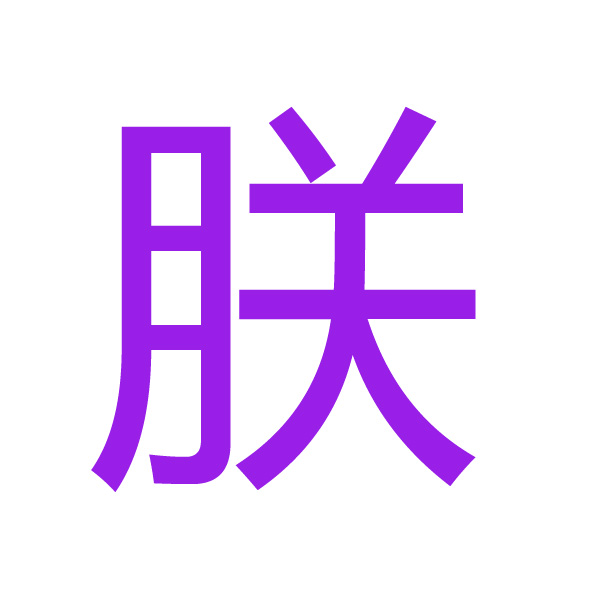
1. Meaning and Usage
The core meaning of the kanji 朕 is the Imperial "We" or the royal "I." It is a first-person pronoun that was used exclusively by the Emperor of Japan.
Important Historical Context:
In 1946, with the post-war Constitution of Japan, Emperor Shōwa (Hirohito) issued the 人間宣言 (Ningen-sengen), or "Declaration of Humanity." In this declaration, he formally renounced his divine status and, crucially, announced the discontinuation of the use of 朕 as the imperial pronoun. Since then, the Emperors have used the common pronoun わたくし (watakushi) in official matters. Therefore, 朕 is now a historical term, found only in pre-1946 documents, historical dramas, and studies of classical Japanese.
Common Reading:
ちん (chin): The Sino-Japanese reading.
2. Correct Stroke Order
Writing 朕 correctly requires attention to its structure. The kanji is composed of the left radical 月 (niku) and the right component 关 (taku).
Total Strokes: 10
Step-by-Step Breakdown:
Left Radical: 月 (Niku-tsuki - Flesh/Moon)
Stroke 1: Left vertical stroke (竖).
Stroke 2: Horizontal折 (oritsu) that forms the top and right side.
Stroke 3: Short upper horizontal stroke inside.
Stroke 4: Short lower horizontal stroke inside. Note: In this context, this radical is the "flesh" radical, not "moon."
Right Component: 关 (Taku)
Stroke 5: Left-falling stroke (撇) from the top.
Stroke 6: Horizontal stroke (横) below it.
Stroke 7: Second horizontal stroke (横).
Stroke 8: Left-falling stroke (撇) from the center.
Stroke 9: Right-dot stroke (捺) for balance.
Key Stroke Order Rules Applied:
Left to Right: The left radical 月 is written before the right component 关.
Top to Bottom: This rule governs the order within the right component.
Enclose before Close: The outer structure of the 月 radical is written before the inner strokes.
3. Historical Origins and Etymology (The "Story" Behind the Kanji)
The history of 朕 is a fascinating journey from a common word to an exclusive imperial title. It is classified as a 形声文字 (keisei moji) or phonetic-ideographic compound.
Let's break down its original components:
Semantic Component (Original Meaning): 舟 (fune)
This is the crucial part. The left side of 朕 was originally 舟, meaning "boat" or "ship." Over time, the script evolved, and 舟 transformed into the similar-looking 月 (flesh) radical.
Phonetic Component (Sound): 关 (taku)
This component provided the ancient Chinese pronunciation.
The Evolution of Meaning:
The original meaning of 朕 was "a crack on the hull of a boat" or, more broadly, "a seam" or "a fissure."
How did a word for a boat's crack become the exclusive pronoun for an emperor?
This is a classic case of "loan usage" (仮借 kasha). The character was borrowed for its sound to represent a first-person pronoun. In very ancient China (during the Qin dynasty and before), 朕 was a common first-person pronoun, equivalent to "I" or "me," used by anyone.
The pivotal change came with Qin Shi Huang, the First Emperor of China. To elevate his status above all others, he decreed that the word 朕 would become the exclusive first-person pronoun for the Emperor alone. This practice was later adopted by the Japanese imperial court, and for centuries, 朕 was the word used by the Japanese Emperor to refer to himself, carrying the immense weight of his divine and sovereign authority.
4. Example Sentences
Since 朕 is a historical term, its usage is confined to pre-1946 imperial proclamations and historical contexts.
In the Pre-war Constitution (The Imperial Rescript on Education):
Romaji: Chin omou ni waga kōso kōsō kuni o hajimuru koto kōen ni...
English: We, the Emperor, reflect upon Our Imperial Ancestors who founded the Empire on a basis broad and everlasting... (This is the famous opening line).
朕惟フニ我カ皇祖皇宗國ヲ肇ムルコト宏遠ニ...
In a Historical Drama:
Romaji: Chin wa kokka sono mono de aru.
English: We are the state itself. (A phrase associated with absolute monarchy).
朕は国家そのものである。
Modern Reference to its Historical Use:
Romaji: `Chin' wa katsute tennō ga mochiita ichininshō da.
English: Chin was the first-person pronoun formerly used by the Emperor.
「朕」はかつて天皇が用いた一人称だ。
Summary
Meaning: The imperial "We" or "I," used exclusively by the Emperor of Japan before 1946.
Writing: 10 strokes. Write the left radical 月 (which evolved from 舟 boat) first, then the right component 关.
Origin: A phonetic-ideographic compound. Its original meaning was a "crack in a boat (舟)." It was borrowed for its sound to be a common first-person pronoun in ancient China. Its status was radically changed when the First Emperor of Qin, Qin Shi Huang, decreed it to be his exclusive pronoun, a tradition later adopted by the Japanese monarchy until it was renounced in the 20th century.