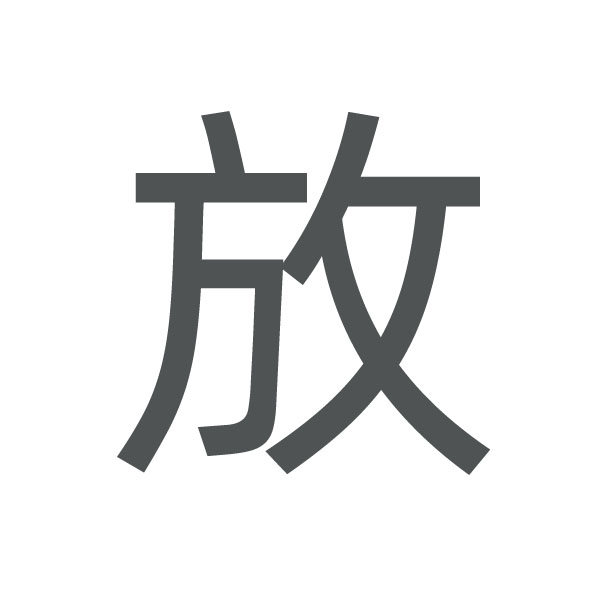
1. Kanji Breakdown: 放
This kanji represents a concept of release, freedom, and emission.
Meaning: To release, to set free, to emit, to fire; to let go; to broadcast.
Reading:
Onyomi (Sino-Japanese reading): ホウ (hou)
Kunyomi (Native Japanese reading): はな(す) (hana(su)), はな(つ) (hana(tsu))
The kanji is a phono-semantic compound (形声文字). It consists of two parts:
Left (方): This means "direction," "way," or "side," and it primarily provides the sound ("hou").
Right (攵): This is the "strike" or "action" radical (ぼくづくり), representing a hand holding a stick, implying action or force.
The character vividly combines the ideas of applying "force/action (攵)" to send something in a "direction (方)." This is the essence of releasing, emitting, or setting free.
2. Stroke Order and Writing
Learning the correct stroke order is crucial for balanced and beautiful kanji. "放" has 8 strokes.
Here is the stroke order diagram and explanation:
Total Strokes: 8
Start with the left part "方":
Then, write the right radical "攵":
Key Writing Tips:
Write from left to right, top to bottom.
The left part "方" is slightly narrower.
The right radical "攵" is written in four distinct strokes. Pay attention to the final right-falling stroke (はね).
The overall character should feel dynamic, as if showing movement or release.
3. Vocabulary and Example Sentences
Here are some common words using "放" and how to use them in sentences.
Vocabulary
放す (はなす, hanasu)
Meaning: To release, to let go, to set free.
Example: 捕まえた魚を放した。
Romaji: Tsukamaeta sakana o hanashita.
English: I released the caught fish.
放送 (ほうそう, housou)
Meaning: Broadcast, broadcasting.
Example: その番組は毎週日曜日に放送される。
Romaji: Sono bangumi wa maishū Nichiyōbi ni housō sareru.
English: That program is broadcast every Sunday.
開放 (かいほう, kaihou)
Meaning: Opening (to the public), liberalization, release.
例文: この施設は一般に開放されている。
Romaji: Kono shisetsu wa ippan ni kaihou sarete iru.
English: This facility is open to the public.
放置 (ほうち, houchi)
Meaning: Neglect, leaving as is, abandonment.
Example: 違法駐車を放置しないでください。
Romaji: Ihō chūsha o houchi shinaide kudasai.
English: Please do not leave illegally parked cars unattended.
放射線 (ほうしゃせん, hōshasen)
Meaning: Radiation (literally, "emitted ray").
Example: 放射線治療を受ける。
Romaji: Hōshasen chiryō o ukeru.
English: To undergo radiation therapy.
放火 (ほうか, hōka)
Meaning: Arson (literally, "releasing fire").
Example: その火事は放火の疑いがある。
Romaji: Sono kaji wa hōka no utagai ga aru.
English: The fire is suspected to be arson.
Summary
Kanji: 放
Core Meaning: To Release, To Set Free, To Emit, To Broadcast.
Readings: On'yomi ホウ (hou), Kun'yomi はなす (hanasu)
Stroke Order: 8 strokes. Remember it's composed of 方 (direction) and 攵 (action). Practice writing it step-by-step to master its dynamic form.
This kanji is essential for talking about freedom, media, and various actions of releasing or emitting. By mastering its stroke order and vocabulary, you will be able to correctly write and use this versatile character.