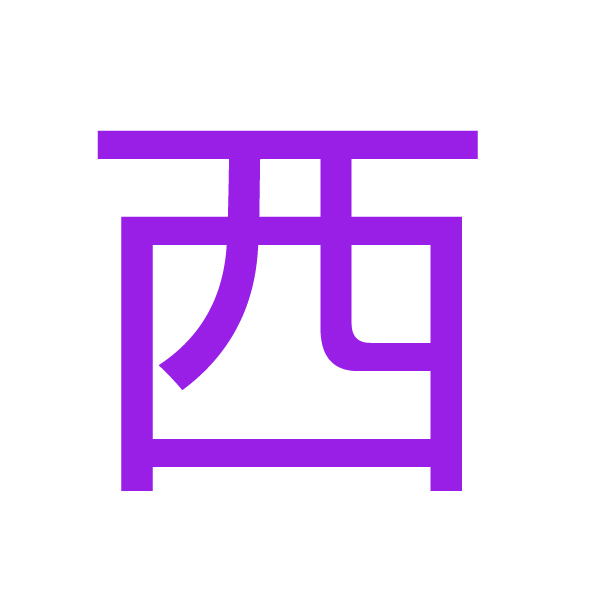
The Kanji: 西 (Nishi/Sei/Sai) - The "West" Kanji
1. Meaning and Usage
Core Meanings: West; Western; Occident
Readings:
Kun'yomi (Japanese reading): にし (nishi)
On'yomi (Chinese reading): セイ (sei), サイ (sai)
Common Words and Compounds:
西 (にし / nishi) - West
西洋 (せいよう / seiyō) - Western countries; the Occident
関西 (かんさい / Kansai) - Kansai region (West of the barrier)
西日本 (にしにほん / Nishi Nihon) - Western Japan
東西 (とうざい / tōzai) - East and West
2. Writing and Stroke Order: The Setting Sun
The correct kanji writing for "西" has a distinctive structure that differs significantly from other directional kanji.
Stroke Order:
Stroke 1: A long horizontal stroke from left to right
Stroke 2: A short vertical stroke on the left
Stroke 3: A short vertical stroke on the right
Stroke 4: A short left-falling stroke inside
Stroke 5: A vertical折 through the center
Stroke 6: A final short horizontal stroke at the bottom
Significance of Correct Kanji Writing:
Enclosure Structure: Follows the "create frame first" principle (strokes 1-3)
Internal Balance: The internal strokes must be properly centered and spaced
Proportions: The character should be slightly wider than tall
3. Historical Origin and Evolution
The history of "西" reveals a practical and observational origin quite different from its directional counterparts.
Oracle Bone Script (甲骨文字):
The earliest form was a pictogram of a bird's nest. It clearly showed:
A curved base representing the nest
Lines representing twigs and materials
Sometimes included a bird resting in the nest
Bronze Script (金文):
The form became more stylized, emphasizing the woven, contained shape of the nest while simplifying the details.
Seal Script (篆書):
The character evolved into a more rectangular form, beginning to resemble the modern enclosure structure while retaining the curved nest imagery.
Modern Form (楷書):
The modern "西" has squared off the original curved lines but maintains the contained, woven appearance.
Conceptual Evolution:
The connection between "bird's nest" and "west" comes from ancient observational logic:
Birds return to their nests in the evening
The sun sets in the west in the evening
Therefore, the nest became associated with the setting sun and western direction
This represents a beautiful example of metonymy - using a related concept (nest) to represent another (west)
Cultural Significance:
In Japanese culture, "西" carries important meanings:
Regional Identity: The 関西 (Kansai) region with its distinct culture centered around Osaka and Kyoto
Cultural Contrast: 西洋 (Western countries) vs 東洋 (Eastern countries)
Spiritual Meaning: West is associated with evening, completion, and in Buddhist context, the Western Pure Land
Modern Context: 西日本 as an important geographical and cultural division
The character embodies the poetic connection between natural cycles (birds returning home) and human spatial understanding.
Summary
The kanji "西" represents a fascinating example of metaphorical thinking in character creation. Beginning as a direct pictogram of a bird's nest - representing the evening return of birds - it evolved through logical association into the symbol for the western direction where the sun sets. Mastering its stroke order and enclosure structure teaches important principles of Japanese kanji writing. When you learn how to write kanji like "西," you're not just learning a direction, but engaging with ancient observational wisdom that connected animal behavior with celestial patterns. This character serves as a beautiful reminder of how traditional cultures found meaning in the daily rhythms of nature, transforming simple observations into enduring symbols that continue to guide our understanding of space and direction in the modern world.