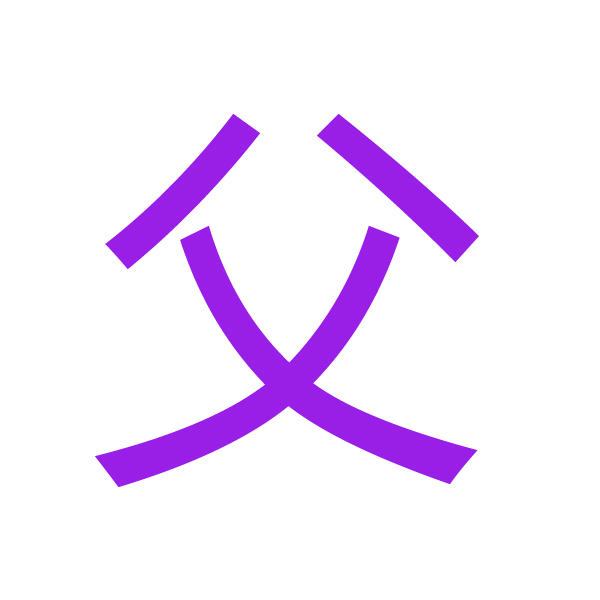
The Kanji: 父 (Chichi/Fu) - The "Father" Kanji
The kanji "父" is a powerful and foundational character representing the concept of "father." Unlike the more intimate "母" (mother), its form and history convey a sense of authority and foundational strength.
1. Meaning and Usage
Core Meaning: Father.
Readings:
Kun'yomi (Japanese reading): ちち (chichi)
Used when referring to one's own father. (e.g., これは私の父です。 - This is my father.)
On'yomi (Chinese reading): フ (fu)
Used in compounds. (e.g., 父母 - fubo - father and mother)
Common Words and Compounds:
父 (ちち / chichi) - (My) father
お父さん (おとうさん / otōsan) - Father (a polite and common term; can be used for one's own father or someone else's)
父親 (ちちおや / chichioya) - A father (as a parent)
父母 (ふぼ / fubo) - Father and mother; parents
祖父 (そふ / sofu) - Grandfather
2. Writing and Stroke Order: A Symbol of Authority
The correct kanji writing for "父" is simple but must be executed with precision to achieve its characteristic balanced and powerful form.
Stroke Order:
Stroke 1: A short left-falling stroke from top to bottom.
Stroke 2: A short right-falling stroke that crosses the first stroke, forming a small "X" or cross at the top. This is the core of the character.
Stroke 3: A right-side dot or short stroke, placed to the upper-right of the cross.
Stroke 4: A left-side dot or short stroke, placed to the upper-left of the cross.
Significance of Correct Kanji Writing:
Balance and Power: The two crossing strokes (1 & 2) form the stable, central axis of the character. The two dots (3 & 4) must be balanced symmetrically to create a sense of order and authority. The entire character should look strong and grounded.
Efficiency: This four-stroke sequence is the most efficient and natural way to form the character, leading to a correct and recognizable shape.
A Common Mistake: A common error is to write the two dots first, followed by the crossed strokes. The correct order (cross first, then dots) is fundamental to correct kanji writing.
3. Historical Origin and Evolution
The history of "父" is not a pictogram of a man, but rather an ideogram of a hand wielding an instrument of authority.
Oracle Bone Script (甲骨文字):
The earliest form clearly depicted a right hand (又) holding a stone axe or a tool (丨). This was not a symbol of violence, but rather a representation of the father's primary role in ancient society: the authority figure who enforced order and the provider who worked with tools.
Bronze Script (金文) & Seal Script (篆書):
The form became more stylized. The representation of the hand and the axe became more abstract, but the relationship between them—the act of grasping a tool—remained the central concept.
Modern Form (楷書):
The modern "父" is a complete abstraction. The original "hand" has evolved into the two crossing strokes, and the "axe" or "tool" has been symbolized by the two dots placed above. While it no longer looks like a hand holding a tool, the essence of authority and executive power is preserved in its strong, crossed structure.
Philosophical and Cultural Connection:
In the Confucian values that deeply influenced Japanese culture, the father is the pillar of the family, the figure of respect and authority. The character "父" embodies this role. It represents the source of discipline, guidance, and protection.
This cultural weight is reflected in the different words for "father":
父 (chichi): A humble term used when speaking about your own father to others.
お父さん (otōsan): A respectful and affectionate term used when addressing your father directly or referring to someone else's father.
Summary
The kanji "父" is a character of strength and authority. It began not as a portrait of a man, but as a symbol of a hand wielding a tool, representing the father's ancient roles as provider and authority figure. Mastering its simple yet precise stroke order is a fundamental step in Japanese kanji writing. When you learn how to write kanji like "父," you are not just learning a word for "father"; you are learning a character that encapsulates a deep-seated cultural concept of paternal strength, responsibility, and respect.