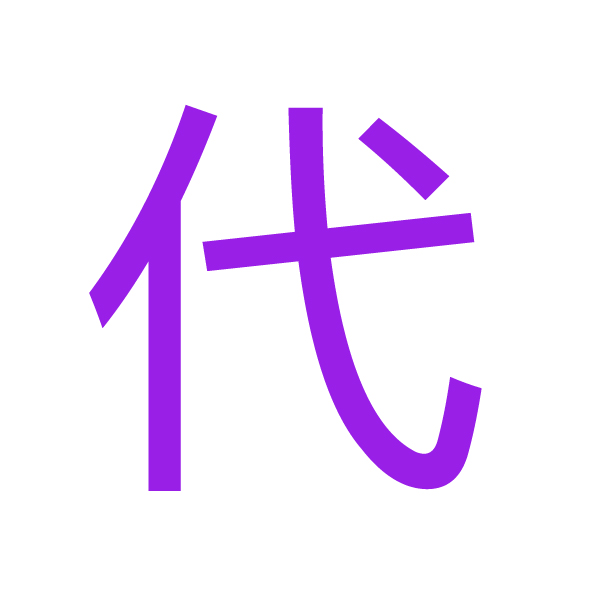
1. Meaning and Usage
The core meaning of the kanji 代 is "substitute," "replace," "generation," "age," or "price." It conveys the idea of one thing taking the place of another, either in terms of people, time, or cost.
It is an extremely common and useful kanji with a wide range of applications.
Common Readings and Words:
だい (dai): Often used for periods of time, generations, or as a suffix for prices.
時代 (jidai): Era, period. (時-time + 代-age)
現代 (gendai): The present age, modernity. (現-present + 代-age)
代金 (daikin): Price, payment. (代-price + 金-money)
~代 (~dai): A suffix for age ranges, e.g., 二十代 (nijūdai) - "(one's) twenties."
か (ka): Used in verbs and words related to substitution.
代わる (kawaru): The basic verb meaning "to replace," "to take the place of."
代える (kaeru): To substitute, to exchange.
交代 (kōtai): Change, alternation, relay. (交-exchange + 代-substitute)
2. Correct Stroke Order
Mastering the stroke order for 代 ensures it is written correctly, balanced, and efficiently. This kanji is composed of the left radical イ (person) and the right component 弋 (shikigamae).
Total Strokes: 5
Step-by-Step Breakdown:
Left Radical: イ (Person)
Stroke 1: The first short撇 (left-falling) stroke, from top-right to bottom-left.
Stroke 2: The vertical竖 (vertical) stroke, from top to bottom. Note: This vertical stroke does not connect to the top of the first stroke; it starts slightly lower.
Right Component: 弋 (Axe/Stake)
Stroke 3: The horizontal stroke, starting from the left, just above the center of the イ radical.
Stroke 4: The斜鉤 (slanted-hook) stroke. This is the key stroke. Start at the top, just to the right of stroke 3, and draw a long, slanted line down to the right, ending in a slight hook upwards.
Stroke 5: The final dot. This dot is placed on the upper part of the slanted-hook stroke.
Key Stroke Order Rules Applied:
Left to Right: You complete the entire left radical (イ) before starting the right component (弋).
Top to Bottom: This is evident within each component.
3. Historical Origins and Etymology (The "Story" Behind the Kanji)
The history of 代 is a great example of how a kanji's meaning can evolve from a concrete image to an abstract concept. It is classified as a 形声文字 (keisei moji) or phonetic-ideographic compound.
Let's break down its components:
Semantic Component (Meaning): イ (人 - hito)
This is the "person" radical. Its presence immediately tells us that the character's original meaning is related to human activity.
Phonetic Component (Sound & Origin): 弋 (yoku)
This is the key to understanding the original meaning. The character 弋 originally depicted a wooden stake or peg used to mark a boundary or a specific spot.
The Combined Meaning:
The original meaning of 代 was not "generation," but "to substitute" or "to replace." The imagery is thought to be one of two things:
Interpretation 1: The Relaying Guard
Imagine a guard post marked by a wooden stake (弋). One person (イ) stands guard, and then is replaced by another person at the change of a shift. The character 代 visually represents this act of one person taking the place of another at a marked post.Interpretation 2: The Boundary Marker
A wooden stake (弋) marks a piece of land. The person (イ) associated with that land (e.g., the owner) can be replaced by another, signifying a change in stewardship or a passing to the next generation.
Evolution of Meaning:
From this core idea of "substitution" and "replacement" between people, the meaning expanded logically:
Substitution in Time: When one generation of people replaces another, it becomes the "next age" or "next generation."
Substitution in Value: When one object (like money) takes the place of another (like a product), it represents its "price" or "cost."
Summary
Meaning: To substitute, replace; generation, age; price.
Writing: 5 strokes. Write the left "person" radical イ first, then the right "stake" component 弋, paying attention to the slanted-hook stroke.
Origin: A phonetic-ideographic compound. The イ (person) radical indicates human activity, while the 弋 (stake) component provided both sound and the original image of a marked post, leading to the core idea of "one person replacing another."
By understanding that the core concept is "replacement," it becomes easy to see the logical connection between all its modern meanings: substituting a person, the passing of a generation (replacement in time), and paying a price (money replacing goods).