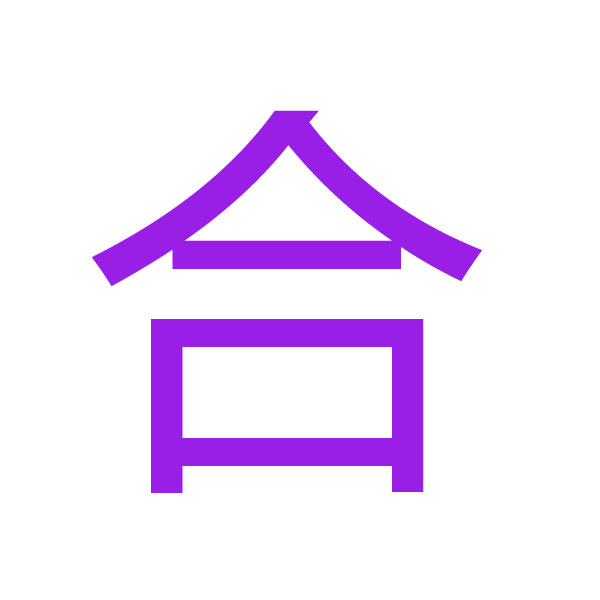
1. Meaning and Usage
The core meaning of the kanji 合 is "to combine," "to join," "to match," "to fit," or "to be correct." It conveys a sense of unity, agreement, and things coming together appropriately.
It is one of the most versatile and commonly used kanji, appearing in a huge number of words.
Common Readings and Words:
ごう (gō): Often used in Sino-Japanese compound words (熟語 jukugo).
合同 (gōdō): Combination, merger, congruence. (合-combine + 同-same)
合成 (gōsei): Synthesis, composition. (合-combine + 成-become)
合図 (aizu): Signal, sign. (合-match + 図-diagram → a "matching diagram" or pre-arranged sign)
合戦 (kassen): Battle, combat. (合-join + 戦-battle → armies joining in battle)
あい (ai): Often used in native Japanese words or as a prefix.
合う (au): The basic verb meaning "to meet," "to match," "to fit," "to suit."
話し合う (hanashiau): To discuss, to talk it over. (話-speak + 合う-mutually)
助け合う (tasukeau): To help each other. (助-help + 合う-mutually)
がっ: A phonetic change in compound words.
合気道 (aikidō): Aikido (the martial art of unifying spirit). (合-harmonize + 気-spirit + 道-way)
2. Correct Stroke Order
Mastering the stroke order for 合 is straightforward and follows fundamental principles, ensuring the character is written correctly and efficiently.
Total Strokes: 6
Step-by-Step Breakdown:
Stroke 1: The first short撇 (left-falling) stroke, from top-right to bottom-left.
Stroke 2: The first short横 (horizontal) stroke, from left to right, just below the first stroke.
Stroke 3: The second short横 (horizontal) stroke, from left to right, parallel to and below stroke 2. (These first three strokes form the top component 亼, an old variant for "to assemble.")
Stroke 4: The long vertical竖 (vertical) stroke that starts in the center, below the top component, and goes straight down.
Stroke 5: The short horizontal stroke to the left of the vertical.
Stroke 6: The final horizontal stroke to the right of the vertical, parallel to stroke 5. (Strokes 4, 5, and 6 form the bottom component 口 (kuchi), meaning "mouth.")
Key Stroke Order Rules Applied:
Top to Bottom: The top component is written completely before the bottom component.
Left to Right: Visible in the horizontal strokes of both the top and bottom parts.
Center before Wings: The central vertical (stroke 4) is written before the horizontal "wings" on its sides (strokes 5 and 6).
3. Historical Origins and Etymology (The "Story" Behind the Kanji)
The history of 合 is a perfect example of an ideographic compound (会意文字 kaii moji), where the meaning is derived from the interaction of its parts.
The kanji 合 is composed of three elements, though it is now typically analyzed as two: the top 亼 (A) and the bottom 口 (kuchi).
亼 (A / jí): This archaic character is itself a pictograph of a lid or a cover. It represents something that is brought down onto another object.
口 (kuchi): This character primarily means "mouth," but in ancient script, it could also represent any open container, vessel, or orifice.
The Combined Meaning:
The character 合 vividly depicts a lid (亼) fitting perfectly onto a container (口). This simple yet powerful image is the source of all its modern meanings:
To fit, to match: The lid must be the correct size for the container.
To combine, to join: The lid and the container are brought together to form a single unit.
To be correct, to agree: When the lid fits, it signifies that things are "right" or "in agreement."
From this concrete image of a lid and container, the meaning expanded abstractly to include the meeting of people (合う au), the agreement of opinions (同意 dōi), and the combination of elements (合成 gōsei).
Summary
Meaning: To combine, join, match, fit, be correct.
Writing: 6 strokes. Write the top lid 亼 first, then the bottom container 口, following the "center before wings" rule for the bottom part.
Origin: An ideographic compound picturing a lid (亼) fitting snugly on a container (口), perfectly encapsulating the concept of things coming together in harmony.
Understanding 合 through this lens transforms it from a simple character into a memorable story about harmony and fit, which is exactly the philosophy behind many Japanese cultural arts like Aikido (合気道), "The Way of Unifying Spirit."