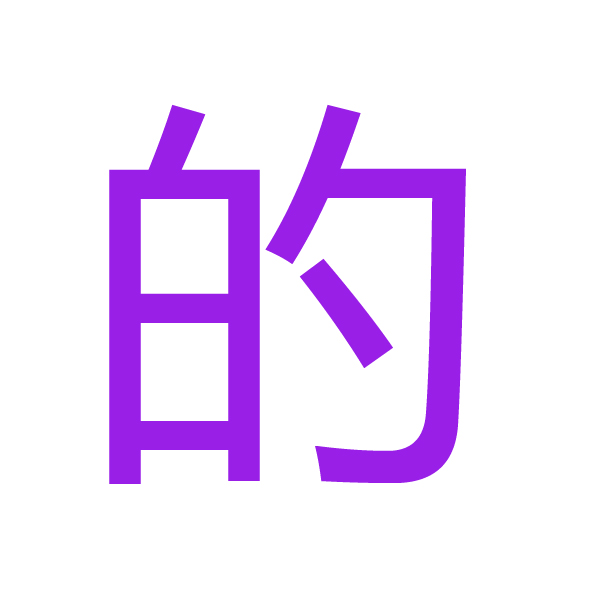
1. The Core Meaning and Usage of "的"
The kanji 的 is one of the most versatile and frequently used characters in Japanese. Its primary function is as a grammatical particle, but it also appears in many compound words.
A. Grammatical Function: The Possessive Marker
This is its most common use.
Meaning: It functions like an apostrophe "s" ('s) or the word "of" in English. It connects two nouns, showing that the first noun belongs to or is associated with the second.
Structure: Noun A + 的 + Noun B = Noun B of Noun A
Examples:
私的 (watashino) = my (as in "my car" 私的な車)
日本的 (Nihonno) = Japan's (as in "Japan's culture" 日本的な文化)
先生的 (senseino) = the teacher's (as in "the teacher's book" 先生的本)
B. As a Suffix: Creating Na-Adjectives
When attached to nouns, it can turn them into adjectives, often meaning "-like," "-ish," or "typical of."
Structure: Noun + 的 (てき)
Reading: In this case, it is usually read as teki.
Examples:
日本的 (nihonteki) = Japanese-like, typical of Japan
具体的 (gutateki) = specific, concrete ("thing-like")
積極的 (sekkyokuteki) = proactive, aggressive
理想的 (risouteki) = ideal
C. Standalone Meaning: "Target" or "Bull's Eye"
In its original sense, it means a "target," "mark," or "goal."
Reading: mato
Examples:
的を射る (mato o iru) = to hit the mark (also used figuratively to mean "to be spot on")
標的 (hyouteki) = target, objective
2. Correct Kanji Writing and Stroke Order
Writing "的" correctly is about balance. It is a left-right structure.
Stroke Order (6 Strokes):
Left Side (White 白):
Stroke 1: A short left-falling slash (㇒).
Stroke 2: A vertical stroke down.
Stroke 3: A small horizontal stroke at the top.
Stroke 4: A second horizontal stroke below it.
Stroke 5: A third, longer horizontal stroke at the bottom, which slightly hooks up at the end. This completes the "白" radical.
Right Side (Spoon/Scoop 勺):
Stroke 6: This is a single, fluid stroke. It starts with a short horizontal dash, then makes a sharp turn downward into a long, sweeping curve that hooks inward at the bottom. This is the key stroke that gives the character its stability.
Visual Guide:
It's highly recommended to watch a short animation. You can find one by searching "的 stroke order" on sites like:
jisho.org
kakijun.jp
Key Writing Tips:
Balance: The left side ("白") should be slightly narrower than the space taken by the right-side curve.
The Hook: The final hook on the right side should not be too exaggerated. It should gracefully enclose the space under the character.
Proportions: The top of both the left and right components should be roughly aligned.
3. Historical Origin and Etymology
The history of "的" beautifully explains how its meanings evolved.
The Pictographic Origin:
The kanji is composed of two parts:White (白): This character originally depicted a white sunbeam or an acorn, but it came to mean "white" or "clear."
Spoon/Scoop (勺): This component depicts a spoon or ladle scooping something.
The Original Meaning:
The combination of these two parts created the original meaning. Imagine a white spoon or a white ladle? This doesn't make immediate sense until you think of its purpose.
Scholars believe it represents a bright, white target. In ancient times, archery targets were often made bright and visible. The "spoon" component (勺) might be a phonetic loan, providing the sound, or it could be seen as a shape that encloses or marks a spot.Evolution of Meaning:
Step 1: Concrete Object: It first meant a physical "target" (like for archery).
Step 2: Abstract Goal: The meaning expanded from a physical target to an abstract "goal" or "objective."
Step 3: Grammatical Particle (The Key Shift in Japanese): This is a uniquely Japanese development. In classical Japanese, the particle "no" (の) was used to indicate possession. However, to add formality or clarity in writing, the Japanese began using kanji to represent these grammatical sounds. They chose the kanji 的 to represent the possessive particle "no" because a "target" is something that is aimed at or belongs to a specific purpose. This created a metaphorical link: "B belongs to A" just as "a target belongs to an archer's aim."
Step 4: Adjectival Suffix: The use as "-teki" likely developed from this possessive/adjectival function, meaning "having the quality of" or "pertaining to."
Summary
| Aspect | Details |
|---|---|
| Kanji | 的 |
| Meanings | 1. Grammatical: Possessive marker ('s, of). 2. Suffix: -like, -ish, typical of. 3. Noun: Target, bull's eye. |
| Readings | Onyomi (Chinese): TEKI Kunyomi (Japanese): mato, no |
| Stroke Order | 6 strokes. Left-right structure. Write the "白" radical first, then the sweeping right stroke. |
| Historical Journey | White (白) + Spoon (勺) → Bright, Visible Target → Abstract Goal → Grammatical Possession (in Japanese) → Adjectival Suffix. |
In essence, "的" went from being a concrete object you shoot arrows at, to an abstract goal you strive for, and finally, in the ingenious adaptation of the Japanese writing system, it became the fundamental grammatical glue that connects ideas and shows belonging.