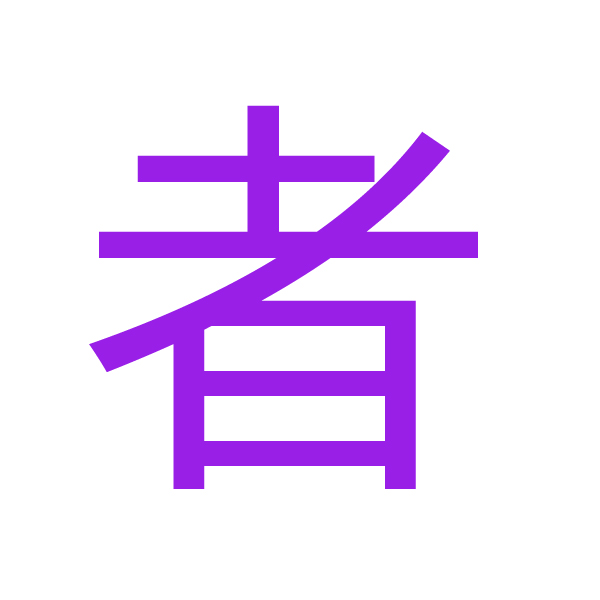
The Kanji: 者 (Mono/Sha) - The "Person" Kanji
The kanji 者 is an essential character that represents the concept of a "person," "someone who does," or "that which is." It is most commonly used as a suffix to denote a person associated with a certain action, profession, or state.
1. Meaning and Usage
Core Meanings: Person; one who; that which; a thing.
Readings:
On'yomi (Chinese reading): シャ (sha)
Kun'yomi (Japanese reading): もの (mono)
Common Words and Compounds:
学者 (がくしゃ / gakusha) - Scholar (A "study" + "person").
作者 (さくしゃ / sakusha) - Author; creator (A "create" + "person").
記者 (きしゃ / kisha) - Reporter (A "record" + "person").
強者 (つわもの / tsuwamono) - A strong person; warrior.
死者 (ししゃ / shisha) - Deceased person (A "death" + "person").
2. Writing and Stroke Order: Building a Complex Form
The correct kanji writing for "者" combines two fundamental components. Mastering its stroke order is key to writing it clearly and efficiently.
Stroke Order:
Stroke 1: A short left-falling stroke.
Stroke 2: A short horizontal stroke, placed just below the first stroke.
Stroke 3: A long horizontal stroke, the widest in the character, providing a stable base for the top part.
Stroke 4: A short vertical stroke downward from the center of the long horizontal.
Stroke 5: A short horizontal stroke on the left side, connecting to the vertical.
Stroke 6: A short horizontal stroke on the right side, mirroring the previous stroke. (Strokes 4, 5, and 6 form the component "曰").
Stroke 7: The radical ⽉ (nikuzuki - "meat/flesh/moon") is written underneath. Start with a left-falling stroke.
Stroke 8: Finish with a horizontal折 (or) stroke, forming the second part of the radical.
Significance of Correct Kanji Writing:
Balance: The top part (the old form of 耂) should be wider than the bottom part (⽉). This creates a stable, top-heavy structure that is characteristic of this kanji.
Component Recognition: Breaking it down into the top (耂) and bottom (⽉) components makes it easier to remember and write. The bottom part is not the moon (月) but the "flesh" radical, which is slightly narrower.
Flow and Legibility: Following this stroke order ensures that the character is well-proportioned and that the internal spaces are clear, which is crucial for correct kanji writing.
3. Historical Origin and Evolution
The history of "者" is complex and involves a fascinating case of phonetic borrowing (rebus).
Oracle Bone Script (甲骨文字):
The original character was not directly related to "person." It depicted a cooking pot (鬲) sitting over a fire (火). This was meant to represent something specific cooking or boiling. The character was used for its sound.
Bronze Script (金文) & Seal Script (篆書):
The form evolved, with the "cooking pot" element becoming more abstract. The "fire" element was sometimes still present. Because this character was used to write a word that sounded like the ancient word for "this" or "that," it gradually took on that meaning through phonetic borrowing.
Clerical Script (隷書) & Modern Form (楷書):
This is where the major transformation happened. The shape of the old "cooking pot" was completely reinterpreted and standardized into the top part of the modern character (耂). The bottom part was formally set as the "⽉" (flesh) radical. The conceptual shift was profound: the character moved from representing a boiling pot to representing "that which is" or "the one who is" a certain way, hence its modern meaning of "person" or "thing."
Conceptual Connection:
The modern meaning of "者" as "person" is abstract. It doesn't describe a physical human like "人" (hito) does. Instead, it defines a person by their attribute, action, or state. An 学者 (gakusha) is a person defined by studying. A 若者 (wakamono) is a person defined by being young. It's a grammatical tool for nominalization (turning verbs/adjectives into "the one who...").
Summary
The kanji 者 offers a fascinating glimpse into the dynamic and sometimes abstract evolution of written language. It transformed from a concrete pictogram of a cooking pot into a crucial grammatical marker for identifying people by their characteristics. Mastering its stroke order is an important step in Japanese kanji writing, as it introduces a common structural pattern. When you learn how to write kanji like "者," you are not just learning a character for "person"; you are learning a key to building a vast vocabulary of professional and descriptive terms, all while connecting to a unique and unexpected historical origin.