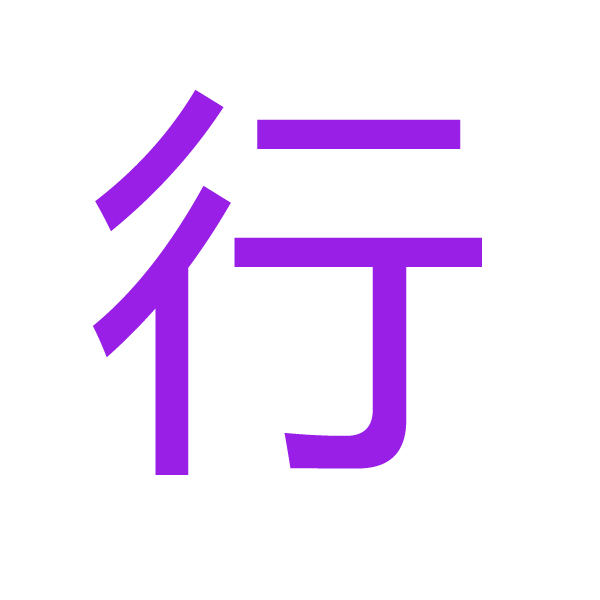
The Kanji: 行 (I.ku/Okona.u/Kō/Gyō) - The "Go" and "Carry Out" Kanji
The kanji "行" is one of the most fundamental and versatile action characters in Japanese. It primarily represents the concepts of "to go," "to journey," and "to carry out" or "to perform." It is also the radical for many other characters related to movement and paths.
1. Meaning and Usage
Core Meanings: To go; to carry out; to perform; line (of text); profession; to be alright.
Readings:
Kun'yomi (Japanese reading): い.く (i.ku), ゆ.く (yu.ku), おこな.う (okona.u)
On'yomi (Chinese reading): コウ (kō), ギョウ (gyō), アン (an)
Common Words and Compounds:
行く (いく / iku) - To go
行う (おこなう / okonau) - To perform; to carry out
旅行 (りょこう / ryokō) - Travel
行事 (ぎょうじ / gyōji) - Event; function
銀行 (ぎんこう / ginkō) - Bank ("Silver establishment")
行書 (ぎょうしょ / gyōsho) - Semi-cursive script ("Going writing")
2. Writing and Stroke Order: The Crossroads
The correct kanji writing for "行" is unique. It is not built from common, simpler components in the same way as many other kanji, so its stroke order should be memorized as a distinct pattern.
Stroke Order:
Stroke 1: A left-falling stroke.
Stroke 2: A right-falling stroke that starts from the same point as the first, crossing it. (Strokes 1 and 2 form the left side of the character).
Stroke 3: A short horizontal stroke on the upper right.
Stroke 4: A long horizontal stroke below it, forming the top of the right side.
Stroke 5: A vertical折 (or) stroke. This is a single stroke that starts as a short horizontal, then turns sharply downward into a long vertical with a hook at the end. This final stroke forms the right side and base of the character.
Significance of Correct Kanji Writing:
Balance and Structure: The character should be well-balanced, with the left side (strokes 1-2) and the right side (strokes 3-5) having roughly equal visual weight. The two long strokes are the left-falling stroke (1) and the final vertical stroke (5).
Radical Recognition: "行" is the "go" radical (ぎょうがまえ, gyōgamae). When it wraps around another component, it transforms into 彳 (the "step" radical). Mastering the full form of "行" is the first step to understanding this radical family (e.g., 街 - street, 術 - art).
Flow: The stroke order is designed for efficient, fluid writing, which is especially important for a character this common.
3. Historical Origin and Evolution
The history of "行" is a perfect example of a pictogram that has remained conceptually clear for millennia.
Oracle Bone Script (甲骨文字):
The earliest form was a clear pictogram of a crossroads. It depicted a central intersection where four (or later two) paths met. This was the ancient symbol for a thoroughfare, a place where one goes.
Bronze Script (金文) & Seal Script (篆書):
The form became more stylized but retained the crossroads imagery. The lines became thicker and more artistic, but the intersection of paths was still the central, unmistakable theme.
Modern Form (楷書):
The modern "行" is a stylized abstraction of the original crossroads. The left side of the character (strokes 1 and 2) represents one path leading to the intersection. The right side (strokes 3, 4, and 5) represents the other path. While it no longer looks like a simple line drawing, the idea of a junction where movement and action happen is perfectly preserved.
Philosophical and Cultural Connection:
"行" embodies the concept of action and progression in both a physical and abstract sense.
Physical Movement: From the simple act of going (行く) to the grander scale of travel (旅行).
Abstract Action: It represents the execution of tasks, from holding an event (行事を行う) to the practice of an art or profession (行 - as in the Buddhist ascetic practices, gyō).
Social Function: A 銀行 (bank) is an "establishment" that "carries out" financial business.
The character connects the concrete image of a path with the abstract ideas of conduct, performance, and the journey of life itself.
Summary
The kanji "行" is a character of action and possibility. It began as a direct drawing of a crossroads—the very symbol of a journey—and evolved into the essential verb for "to go" and "to do." Mastering its unique stroke order is a crucial step in Japanese kanji writing, as it is a high-frequency character and a foundational radical. When you learn how to write kanji like "行," you are not just learning a word; you are learning a symbol that represents all movement, action, and the paths we take in life, both physical and metaphorical. It is the character for every journey, from a walk to the store to the execution of a grand plan.