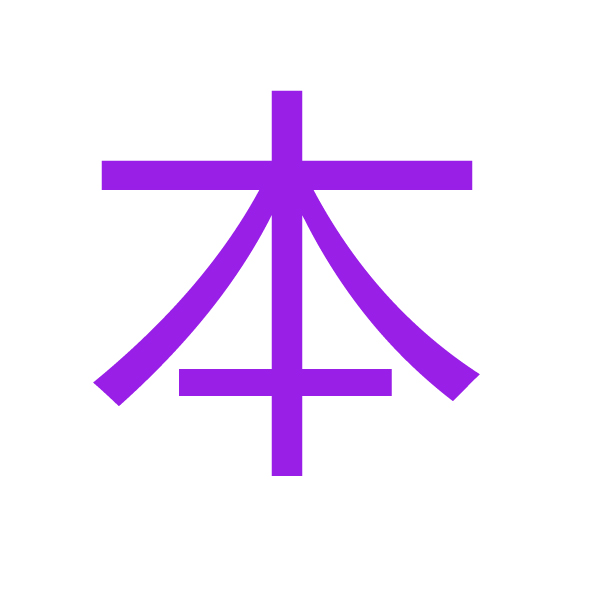
The Kanji: 本 (Moto/Hon) - The "Origin" and "Book" Kanji
The kanji "本" is one of the most fundamental and versatile characters in Japanese. Its core meaning is "origin" or "root," from which its other common meaning of "book" logically extends.
1. Meaning and Usage
Core Meanings: Origin; basis; root; source; book; main; true.
Readings:
Kun'yomi (Japanese reading): もと (moto)
On'yomi (Chinese reading): ホン (hon)
Common Words and Compounds:
本 (ほん / hon) - Book
本物 (ほんもの / honmono) - The real thing; genuine (True thing)
日本 (にほん / Nihon) - Japan (Origin of the Sun)
本屋 (ほんや / hon'ya) - Bookstore
基本的 (きほんてき / kihonteki) - Fundamental; basic
本気 (ほんき / honki) - Seriousness; in earnest (True spirit)
2. Writing and Stroke Order: Marking the Root
The correct kanji writing for "本" is simple but must be precise. It is based on the kanji for "tree" (木) with an added mark to indicate the essential part.
Stroke Order:
Stroke 1: A long horizontal stroke from left to right. (The branches of the tree)
Stroke 2: A long vertical stroke that starts above the horizontal and extends down through it. (The trunk of the tree)
Stroke 3: A left-falling stroke attached to the vertical. (The roots)
Stroke 4: A right-falling stroke attached to the vertical. (The roots)
Stroke 5: A short horizontal stroke (or a dot) at the base of the trunk. This is the crucial mark.
Significance of Correct Kanji Writing:
The Defining Mark: The fifth stroke is the entire point of the character. It highlights the root or base of the tree. This transforms 木 (tree) into 本 (origin/root).
Balance: The character should be balanced. The horizontal stroke at the bottom should be centered and distinct, clearly marking the base without making the character look bottom-heavy.
A Common Mistake: A common error is to make the fifth stroke a long horizontal that connects to the roots, which would confuse it with another character. It must be a short, distinct mark.
3. Historical Origin and Evolution
The history of "本" is a clear and brilliant example of an "indicative" or "ideographic" character, where a simple mark added to a pictogram creates a new, abstract meaning.
Oracle Bone Script & Bronze Script:
The character was based on the pictogram for "tree," 木. To indicate the concept of the "root" or "origin," a few short strokes or a dot were added to the lower part of the tree.
Seal Script:
This form became more standardized. The mark at the bottom was often represented by a short, thick stroke or a dot nestled between the roots of the tree.
Modern Form:
The modern "本" is a clean abstraction. The mark at the base has been standardized into the short horizontal stroke we see today. The original meaning of "the root of a tree" is perfectly preserved.
Philosophical and Conceptual Connection:
The genius of "本" lies in how its meaning expanded from a physical root to abstract concepts:
The "Root" -> The "Origin" or "Source": The fundamental basis of anything. This is its core meaning, seen in words like 基本 (kihon - foundation).
The "Origin" -> The "Main" or "True" Thing: What is original is often considered the real and primary version, as in 本物 (honmono - the genuine article) and 本気 (honki - true feeling/seriousness).
The "Main" Text -> "Book": In ancient times, important texts were written on bamboo strips. The main, original version of a text was bound together, and this came to be called a "book" (本). A book contains the "root" or "source" of knowledge.
This is why Japan is called 日本 (Nihon)—it is the "Origin of the Sun," from the perspective of China.
Summary
The kanji "本" is a character of profound simplicity and logical depth. It began as a simple mark on a "tree" to indicate its "root" and evolved into a symbol for the most fundamental concepts: origin, truth, and the source of knowledge (a book). Mastering its stroke order, particularly the significant mark at the base, is a foundational step in Japanese kanji writing. When you learn how to write kanji like "本," you are not just learning a character for "book"; you are learning a symbol that points to the very root of things, making it one of the most conceptually important characters in the entire language.