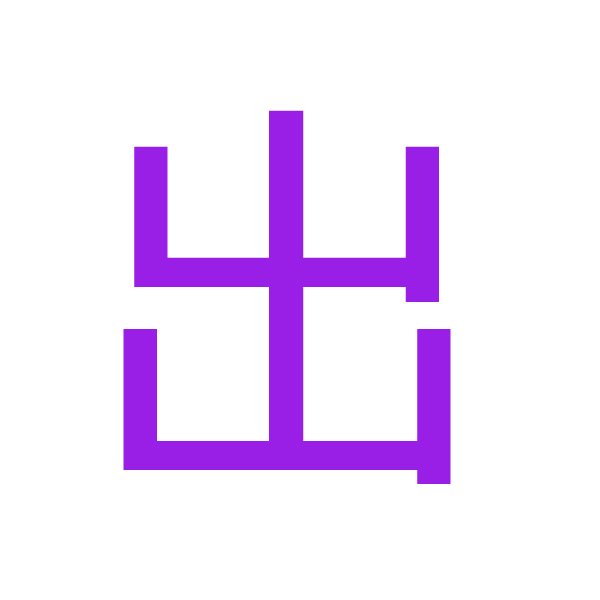
The Kanji: 出 (De.ru / Shu.tsu) - The "Exit" Kanji
The kanji 出 is a dynamic character that represents the concept of "to go out," "to exit," "to emerge," or "to appear."
1. Meaning and Usage
Core Meanings: To exit, to leave, to emerge, to appear, to produce.
Readings:
Kun'yomi (Japanese reading): で.る (de.ru), だ.す (da.su)
On'yomi (Chinese reading): シュツ (shutsu)
Common Words and Compounds:
出る (でる / deru) - To go out; to leave; to appear.
出す (だす / dasu) - To take out; to send; to submit.
出口 (でぐち / deguchi) - Exit (Literally "out-mouth").
出席 (しゅっせき / shusseki) - Attendance (Literally "to be present/emerge at a seat").
発出 (はっしゅつ / hasshutsu) - To issue; to dispatch.
2. Writing and Stroke Order: A Logical Sequence
The correct kanji writing for "出" is a great example of a character built from a repeated element. Its stroke order is logical and ensures a balanced shape.
Stroke Order:
Stroke 1: A left-falling stroke, starting from the top-left and sweeping down.
Stroke 2: A vertical折 (or) stroke. Start with a short horizontal line, then turn sharply downward. This forms the first "mountain" or "footprint."
Stroke 3: A long vertical折 (or) stroke. This is the core of the character. Start with a horizontal line (longer than the one in Stroke 2), turn sharply downward, and draw a long vertical line that extends below the first element.
Stroke 4: A vertical折 (or) stroke that fits inside the bottom-left of the long vertical from Stroke 3. Start with a short horizontal, then turn downward.
Stroke 5: A final vertical折 (or) stroke that fits inside the bottom-right. Start with a short horizontal, then turn downward.
Significance of Correct Kanji Writing:
Building from the Bottom: The character is constructed from the bottom up. The long central stroke (Stroke 3) acts as the backbone, with the smaller elements attached to it. This structure is key to its balance.
Repetition and Rhythm: The character uses the same "footprint" shape multiple times. The correct stroke order establishes a rhythm that makes the character faster and more natural to write.
Proportions: The bottom part of the character should be wider and more grounded than the top part, visually reinforcing the idea of something "emerging" from a base.
3. Historical Origin and Evolution
The history of "出" is a clear and intuitive example of ancient ideographic creation.
Oracle Bone Script (甲骨文字):
The original character was a vivid ideogram. It depicted a footprint (止) stepping out of a depression or a pit, like a footprint leaving a cave or a hollow. In ancient times, the character for "foot" or "footprint" (止) was used to represent movement. The "pit" was often represented by a simple container-like shape.
Bronze Script (金文) & Seal Script (篆書):
The form became more stylized. The "footprint" component was simplified, and the "pit" or "boundary" from which it was emerging became more defined. The concept remained unmistakable: movement away from a starting point.
Modern Form (楷書):
The modern "出" is a significant abstraction. The original "footprint" (止) has been stylized into the two stacked elements we see today. It no longer looks like a footprint stepping out of a hole, but the concept of "emergence" is preserved in its structure, which suggests something repeating or progressing outward.
Conceptual Connection:
The core idea is one of movement from an interior to an exterior. This is why it applies to both physical acts (leaving a room) and abstract ones (publishing a book - 出版 / shuppan, or an idea appearing - 出現 / shutsugen). It represents the moment of transition from "in" to "out."
Summary
The kanji 出 provides a fantastic lesson in how abstract concepts were turned into written characters. It began as a literal picture of a footprint leaving a boundary and evolved into a stylized symbol built on repetition and vertical movement. Mastering its stroke order is essential for correct kanji writing, as it teaches the important skill of building a complex character from a central, repeating component. When you learn how to write kanji like "出," you are not just memorizing lines; you are internalizing the logic and history of a symbol that captures the universal action of "going out."