The Kanji: 年 (Nen/Toshi) - The "Year" Kanji
The kanji 年 is an essential character representing the concept of a "year" and is deeply connected to the cycles of agriculture and life.
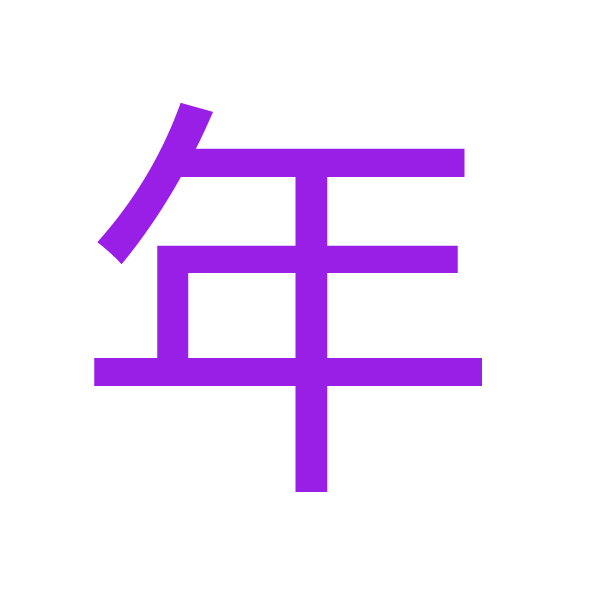
1. Meaning and Usage
Core Meanings: Year; Age; Harvest Period.
Readings:
On'yomi (Chinese reading): ネン (nen)
Kun'yomi (Japanese reading): とし (toshi)
Common Words and Compounds:
一年 (いちねん / ichinen) - One year.
今年 (ことし / kotoshi) - This year.
年月日 (ねんがっぴ / nengappi) - Date (Year, Month, Day).
少年 (しょうねん / shōnen) - Boy; youth.
年上 (としうえ / toshiue) - Older (in age).
2. Writing and Stroke Order: Mastering a Common Structure
Learning the correct kanji stroke order for "年" is crucial as it combines several fundamental strokes and is used very frequently.
Stroke Order:
Stroke 1: A short left-falling stroke from top to bottom.
Stroke 2: A short horizontal stroke from left to right, placed just below the top of the first stroke.
Stroke 3: A long horizontal stroke from left to right, below the second stroke. This is the main "crossbar" and should be the widest part of the character.
Stroke 4: A vertical stroke that starts above the long horizontal, cuts through it, and continues down to the bottom. This is the central "spine" of the character.
Stroke 5: A short left-falling stroke attached to the central vertical.
Stroke 6: A right-falling stroke attached to the central vertical, just below the previous stroke.
Significance of Correct Kanji Writing:
Balance is Key: The long third stroke (horizontal) provides width, while the strong fourth stroke (vertical) provides height and stability. Getting this balance right is essential for correct kanji writing.
Common Pattern: The top part of "年" (the first four strokes) is a common component you will see in other kanji. Mastering it here helps with characters like 牛 (cow) and 午 (noon).
Efficiency and Flow: This prescribed stroke order ensures your hand moves efficiently across the page and naturally leads to a well-proportioned character.
3. Historical Origin and Evolution
The history of "年" is intimately tied to ancient agricultural society.
Oracle Bone Script (甲骨文字):
The original character was a pictogram representing the harvest. It depicted a stalk of grain (禾) with heavy, ripe ears of rice or millet at the top, and sometimes included a person (人) below, symbolizing carrying the harvest.
Bronze Script (金文) & Seal Script (篆書):
The form evolved, combining the "grain" component (禾) and the "person" component (人) more clearly. The idea was that a "year" was defined by one complete cycle of the harvest—from planting to reaping. The time it took to grow and harvest the grain was a year.
Modern Form (楷書):
The modern "年" is a highly stylized and simplified form. The "person" (人) component at the bottom has transformed into the final two strokes, which are now abstract and no longer recognizably human. The "grain" component at the top has also been simplified into the first three horizontal strokes. However, the core meaning, "the time of harvest," remains locked within the character's form.
Cultural Connection:
This origin explains why お正月 (Oshōgatsu), the Japanese New Year, is such an important festival. It has its roots in celebrations for a good harvest and prayers for the next. The character "年" itself embodies this cycle of time, growth, and life.
Summary
The kanji 年 is a beautiful example of how language, culture, and livelihood are intertwined. It started as a literal picture of a grain harvest and evolved into the abstract symbol for a "year." Mastering its stroke order is a key step in Japanese kanji writing, as it teaches balance and a common structural pattern. When you learn how to write kanji like "年," you are not just learning a character; you are learning a piece of history that connects the measurement of time to the rhythm of the earth.