The Kanji: 大 (Dai/Ōkii) - The "Big" Kanji
The kanji 大 is a simple yet powerful character that represents the concept of "big," "large," or "great." It builds directly upon the foundational kanji "人" (person).
1. Meaning and Usage
Core Meanings: Big, Large, Great, Extensive.
Readings:
On'yomi (Chinese reading): ダイ (dai), タイ (tai)
Kun'yomi (Japanese reading): おお- (ō-), おお.きい (ōkii)
Common Words and Compounds:
大きい (おおきい / ōkii) - Big (an adjective).
大学 (だいがく / daigaku) - University (Literally "big learning").
大好き (だいすき / daisuki) - To love something (Literally "big liking").
大人 (おとな / otona) - Adult (Literally "big person").
大地 (だいち / daichi) - Great earth; ground.
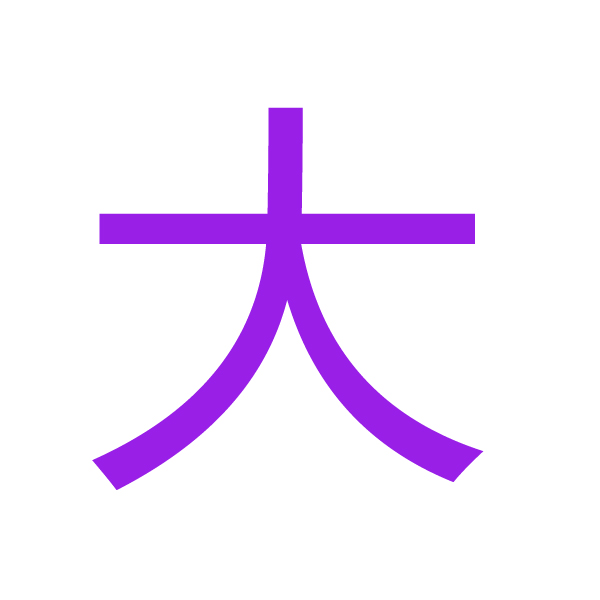
2. Writing and Stroke Order: The Posture of Largeness
The correct kanji writing for "大" demonstrates how a simple modification to a basic character can create a new meaning. Its stroke order is logical and essential for balance.
Stroke Order:
Stroke 1: A long horizontal stroke from left to right. This is the "ground" or the "span" that conveys breadth.
Stroke 2: A left-falling stroke that starts from the center-top, crossing the horizontal stroke, and sweeps down to the left.
Stroke 3: A right-falling stroke that starts from the same point as the second stroke, crossing the horizontal stroke, and sweeps down to the right.
Significance of Correct Kanji Writing:
Balance and Symmetry: The key to writing "大" beautifully is balance. The horizontal stroke should be long and level. The two diagonal strokes should spring from the same point and create a symmetrical, stable posture, much like a person standing with arms and legs spread out to claim space.
Foundation in "人": If you know the kanji for "person" (人), "大" can be seen as a person who has "grown big" and is stretching out their arms. This conceptual link helps in memorization.
A Rule of Thumb: This character reinforces the fundamental stroke order rule: top to bottom and left to right (the left-falling stroke is written before the right-falling one).
3. Historical Origin and Evolution
The history of "大" is a clear and intuitive example of ancient character creation.
Oracle Bone Script (甲骨文字):
The original form was a pictogram of a standing human figure with outstretched arms and legs. While "人" (person) was a profile view of a person, possibly bowing, "大" was a frontal view designed to emphasize the idea of size and grandeur. A person standing with arms and legs spread wide takes up more space and appears "big."
Bronze Script (金文) & Seal Script (篆書):
The form became more stylized but retained the frontal human shape. The head, body, arms, and legs were all clearly distinguishable, though represented by thicker, more symbolic lines.
Modern Form (楷書):
The modern "大" is a complete abstraction. The curved lines of the body have been straightened into a single horizontal line (the arms) and two angled lines (the torso and legs). The original pictographic meaning is no longer obvious, but the conceptual link remains: a person in a "large" posture.
Philosophical and Cultural Connection:
In East Asian thought, "大" often carries a positive connotation of greatness and importance. It is used in words like 大国 (taikoku - great power/nation) and 大器 (taiki - a person of great talent or caliber). It signifies something that is not just physically large, but also significant in scale, value, or influence.
Summary
The kanji 大 perfectly illustrates how the Japanese writing system builds meaning logically. By modifying the basic shape of a "person" (人), it creates the concept of "big." Mastering its stroke order is crucial for achieving balanced and correct handwriting. Understanding its history—from a pictogram of a person claiming space to the modern symbol for "greatness"—transforms the process of learning kanji from mere memorization into an engaging exploration of culture and visual language.