The Kanji: 人 (Hito) - The "Person" Kanji
The kanji 人 is one of the first and most fundamental characters learned in Japanese. It represents the concept of a "person" or "human being."
1. Meaning and Usage
Core Meaning: Person, human being.
Readings:
Kun'yomi (Japanese reading): ひと (hito)
On'yomi (Chinese reading): ジン (jin), ニン (nin)
Common Words and Compounds:
一人 (ひとり / hitori) - One person; alone. (Combines the kanji for "one" 一 and "person" 人).
日本人 (にほんじん / nihonjin) - A Japanese person. (Here, 人 means "-ese" or "-ian," denoting nationality).
人間 (にんげん / ningen) - Human being; humanity.
人生 (じんせい / jinsei) - Human life. (Literally "person-life").
大人 (おとな / otona) - Adult. (Literally "big person").
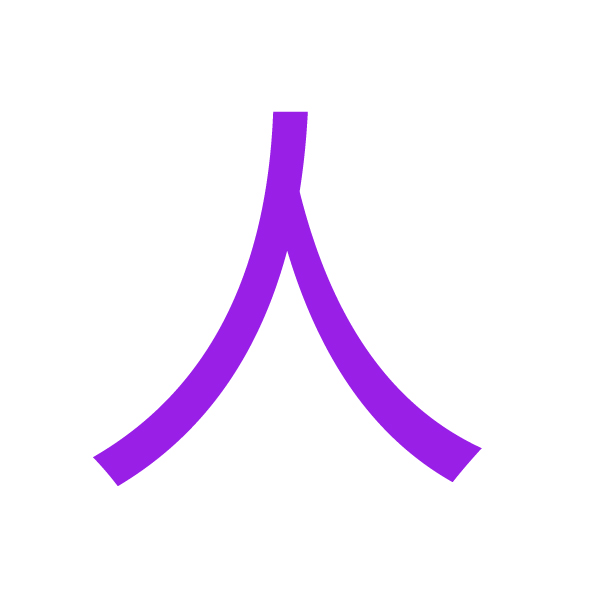
2. Writing and Stroke Order
Learning the correct stroke order for "人" is crucial, as it forms the basis for many other kanji.
Stroke Order:
Stroke 1: A left-falling stroke. Start from the top-center and sweep down to the left.
Stroke 2: A right-falling stroke. Start from a point slightly below the top, to the right of the first stroke's starting point. Sweep down to the right, and at the end, briefly pause or make a subtle hook. This second stroke often "supports" the first one.
Writing Significance:
The two strokes represent the two legs of a human standing upright. The simplicity and balance of the character are key to writing it elegantly. Mastering the graceful, angled strokes of "人" is a foundational skill in Japanese calligraphy (書道, shodō).
3. Historical Origin and Evolution
The history of "人" is a fascinating journey from a pictogram to an abstract symbol.
Oracle Bone Script (甲骨文字, c. 1600–1046 BCE):
The earliest form of "人" was a side-view pictogram of a person bowing or kneeling. It depicted a figure with a head, a body, an arm, and a leg bent at the knee. This profile view was likely chosen because it was the simplest way to distinguish a human form from other animals.
Bronze Script (金文) & Seal Script (篆書):
Over centuries, the character became more stylized and abstract. The curved lines of the body and leg were straightened, gradually forming the angled shape we recognize today. By the time of the Seal Script, it had evolved into a more symmetrical, two-stroke figure.
Modern Form (楷書):
The modern, printed form of "人" is a final abstraction of the ancient pictogram. The head and the detailed body have disappeared, leaving only the two essential strokes that symbolize the core of a human: our upright posture.
Philosophical Connection:
The character's evolution into two supporting strokes can be seen as a philosophical idea: that a human being is a creature who stands on two legs, implying independence, but also that we rely on mutual support and community to remain upright.
Summary
In essence, the kanji 人 is a beautiful example of how written language evolves. It started as a simple drawing of a person in profile and, over 3,000 years, refined itself into a minimalist and elegant symbol that carries the profound meaning of what it is to be human. Its correct stroke order is not just a rule to follow but a continuation of this ancient artistic and cultural tradition.