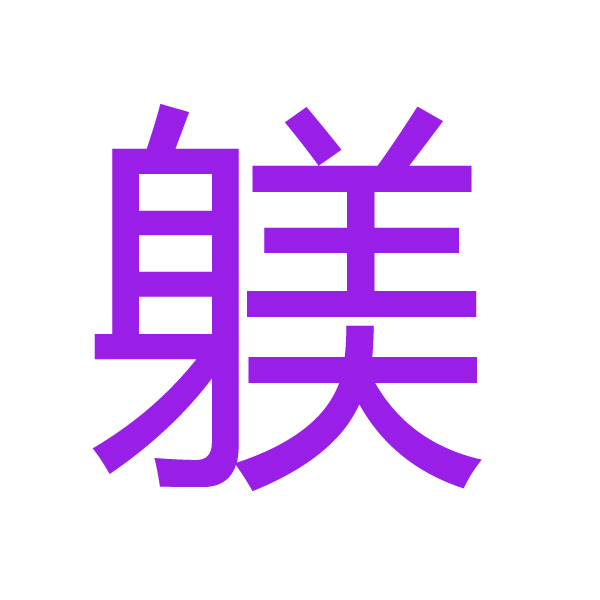
3. Historical Origins and Etymology (The "Story" Behind the Kanji)
The history of 躾 is a brilliant example of Japanese linguistic creativity. As a 国字 (kokuji), it was constructed by combining two existing kanji to express a uniquely Japanese cultural concept.
The kanji 躾 is composed of two simple yet profound components:
身 (Mi): This character means "body," "oneself."
美 (Mi): This character means "beauty," "beautiful."
The Combined Meaning:
The meaning of 躾 is created by the powerful and elegant combination of these two parts:
"To make beauty (美) a part of one's very body (身)."
This is a deeply philosophical concept. 躾 is not merely about enforcing rules; it is about the process of internalizing good manners and virtuous conduct until they become second nature—as instinctive and inseparable from a person as their own body. The goal is to cultivate an inner beauty that is reflected in one's outward actions and posture.
It implies that true discipline is not an external force but an internalized art form, where proper behavior becomes a kind of physical grace.
4. Example Sentences
Here are some example sentences showing the use of 躾.
As a Noun "Upbringing" (しつけ):
Romaji: Kanojo wa shitsuke ga shikkari shite iru.
English: She has good manners/is well-disciplined. (Lit: Her upbringing is solid.)
彼女は躾がしっかりしている。
As a Verb "To Discipline" (しつける):
Romaji: Kodomo ni reigi o shitsukeru no wa oya no yakume da.
English: It is a parent's role to discipline their children in manners.
子供に礼儀を躾けるのは親の役目だ。
General Concept:
Romaji: Shokuji no shitsuke wa taisetsu desu.
English: Table manners are important.
食事の躾は大切です。
Summary
Meaning: Upbringing, discipline, training, manners.
Writing: 16 strokes. Write the left "body" component 身 first, then the right "beauty" component 美.
Origin: A 国字 (kokuji), a character created in Japan. It combines 身 (body) and 美 (beauty) to express the concept of "making beauty a part of one's body." This refers to the process of internalizing good conduct and manners until they become instinctive and natural, reflecting a deep connection between physical discipline and inner virtue.