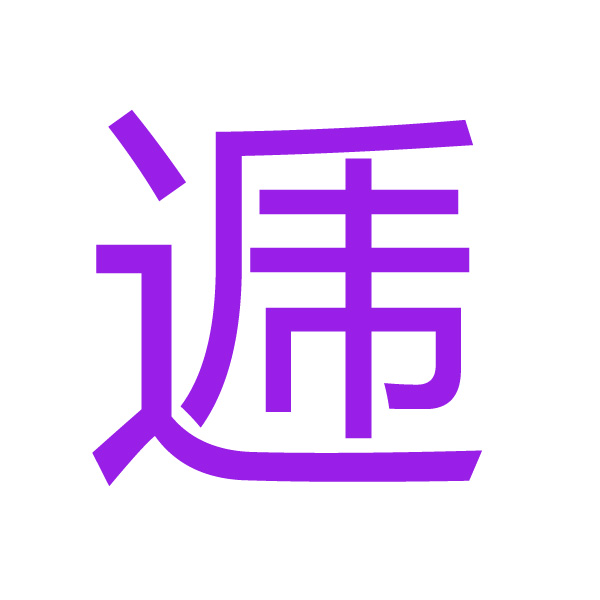
1. Meaning and Usage
The core meaning of the kanji 逓 is "to alternate," "to relay," "to hand over in succession," or "gradual change." It conveys the idea of something being passed along in stages or changing progressively.
Common Readings and Words:
てい (tei): The Sino-Japanese reading, used in compound words.
逓信 (teishin): Communications, postal services. (逓-relay + 信-message → "relaying messages")
逓減 (teigen): Gradual decrease, tapering off. (逓-gradual + 減-decrease)
逓増 (teizō): Gradual increase. (逓-gradual + 増-increase)
逓送 (teisō): Forwarding, sending on. (逓-relay + 送-send)
The most common and important word is 逓信 (teishin), which was historically used in the name of the 逓信省 (Teishin-shō), the Ministry of Communications and Postal Services.
2. Correct Stroke Order
Writing 逓 correctly requires attention to its structure. The kanji is composed of the left radical 辶 (shinnyō - to move) and the right component 丗 (a variant of 世).
Total Strokes: 10
Step-by-Step Breakdown:
Right Component: 丗 (Sei - Generation)
Stroke 1: Horizontal stroke (横).
Stroke 2: Vertical stroke (竖).
Stroke 3: Short vertical stroke (竖).
Stroke 4: Short vertical stroke (竖).
Stroke 5: Horizontal stroke at the bottom (横). Note: This component is written first, before the enclosing walking radical.
Left/Enclosing Radical: 辶 (Shinnyō - To Walk/Move)
Stroke 6: Dot on the top (点).
Stroke 7: A curved stroke that goes down and to the left (this stroke starts below the dot).
Stroke 8: The final stroke is a long, smooth curve that sweeps under the right component (捺).
Key Stroke Order Rules Applied:
Right to Left (for Enclosing Radicals): For kanji with the 辶 radical, you always write the internal component first (丗), and then the enclosing walking radical.
Top to Bottom: This rule governs the order within the 丗 component.
3. Historical Origins and Etymology (The "Story" Behind the Kanji)
The history of 逓 is a clear example of an ideographic compound (会意文字 kaii moji), where the meaning is logically derived from its parts.
Let's break down its components:
辶 (Shinnyō): This radical means "to walk," "to move," or "a path." It indicates that the character's meaning is related to movement or progression.
丗 (Sei): This component is an old variant of the kanji 世 (yo), which means "generation," "world," or "age." The character 世 itself originally depicted "thirty" (十 ten + 十 ten + 十 ten), representing a generation of about thirty years.
The Combined Meaning:
The character 逓 creates a powerful and intuitive concept:
"To move (辶) through successive generations (丗/世)."
This imagery perfectly captures the idea of:
Relaying: Passing a baton from one generation (or person) to the next, like a relay race.
Alternating: The succession of one generation after another.
Gradual Change: The slow, progressive change that happens over generations.
The core idea is not a single, direct action, but a process that happens in stages, handed down along a path. This is why it is used in 逓信 (communications), which involves messages being passed from post office to post office, and in 逓減 (gradual decrease), which implies a step-by-step reduction.
4. Example Sentences
Here are some example sentences showing the use of 逓 in its common compounds.
In "Communications" (ていしん):
Romaji: Teishin-shō wa genzai no Sōmu-shō to Nippon Yūsei no zenshin da.
English: The Ministry of Communications was the predecessor of the current Ministry of Internal Affairs and Communications and Japan Post.
逓信省は現在の総務省と日本郵政の前身だ。
As "Gradual Decrease" (ていげん):
Romaji: Kono kusuri no ryō wa teigen shite iku hitsuyō ga aru.
English: The dosage of this medicine needs to be gradually decreased.
この薬の量は逓減していく必要がある。
As "Gradual Increase" (ていぞう):
Romaji: Shigoto no fuka ga teizō shiteiru.
English: The workload is gradually increasing.
仕事の負荷が逓増している。
Summary
Meaning: To alternate, to relay, gradual change.
Writing: 10 strokes. Write the internal right component 丗 (generation) first, then the enclosing left radical 辶 (to move).
Origin: An ideographic compound. It combines 辶 (to move) with 丗/世 (generation) to create the meaning of "moving through successive generations." This powerful image of step-by-step progression over time is the foundation for all its modern meanings, from relaying mail to gradual change.