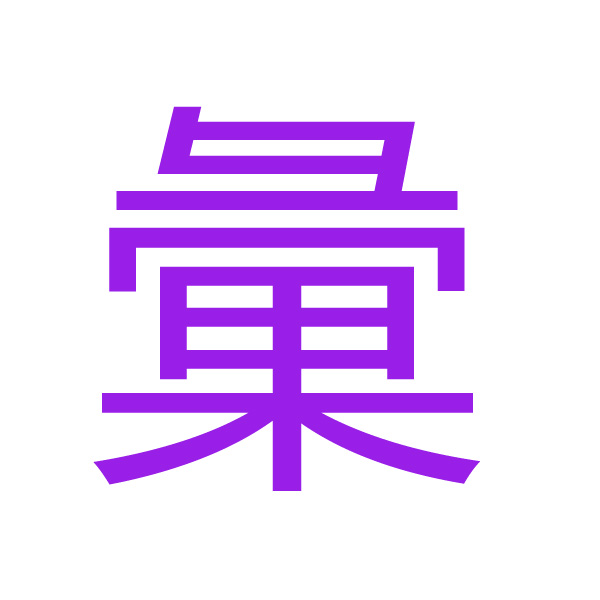
1. Meaning and Usage
The core meaning of the kanji 彙 is "collection," "classification," or "glossary." It refers to a group of similar things gathered together and systematically arranged. This kanji is classified as a 常用外漢字 (Jōyōgai kanji), meaning it is not included in the official list of 2,136 "regular-use" characters. You will encounter it primarily in formal, academic, or technical contexts.
Common Readings and Words:
い (i): The Sino-Japanese reading, used in specific compound words.
語彙 (goi): Vocabulary, lexicon. (語-word + 彙-collection → "a collection of words")
品彙 (hin'i): A classified collection of things; a category.
彙報 (ihō): A collected report; transactions (of a scholarly society).
By far, the most common and important word is 語彙 (goi), which is essential for anyone studying the Japanese language.
2. Correct Stroke Order
Writing 彙 correctly is complex due to its high stroke count and intricate structure. It is a compound character built from several components.
Total Strokes: 13
Step-by-Step Breakdown:
The character can be broken down into a top part and a bottom part.
Top Part: 𣎺 (A variant of 彚)
Begin with the central vertical stroke and the surrounding "bristle" strokes on top.
Write the enclosing 冖 (covering) radical.
Complete the internal structure, which includes the 田 (rice field) component.
This part itself is complex. The general order is:
Bottom Part: 彑 (Kei - Pig's Head/Snout)
This is the lower radical. It is written after the top part is complete, following the "top to bottom" rule.
Detailed Sequence (Simplified):
Start with the central top strokes.
Write the covering radical 冖.
Complete the internal 田 and connecting strokes.
Finish with the bottom radical 彑.
Key Stroke Order Rules Applied:
Top to Bottom: The entire top component is written before the bottom radical 彑.
Enclose before Close: The outer structure is established before filling in internal details.
Center before Wings: The central strokes are often written before the side strokes in the top section.
3. Historical Origins and Etymology (The "Story" Behind the Kanji)
The history of 彙 is a fascinating example of an ideographic compound (会意文字 kaii moji), where the original meaning was very concrete.
Let's break down its original components:
𣎺 / 彚 (Ki): This top component is the core of the character. It is a pictograph representing a hedgehog or a porcupine. The top part represents the bristling spines of the animal.
彑 (Kei): The bottom component means "pig's head" or "snout." In this character, it is thought to represent the body of the animal.
The Combined Meaning and Evolution:
The original meaning of 彙 was "hedgehog" or "porcupine."
So, how did a character for a hedgehog come to mean "collection" or "classification"?
The connection is brilliantly metaphorical. A hedgehog is an animal that is defined by its collection of numerous spines. These spines are all similar in nature and are gathered together on one body.
From this vivid image, the meaning abstracted:
From a "collection of spines on an animal"
To the general concept of a "collection of similar things"
And further to the act of "classifying" those things into a group.
This is a process known as semantic extension. The character was borrowed for its conceptual imagery rather than its literal meaning. The idea of a hedgehog, with its distinctive and unified collection of quills, became the perfect symbol for any grouped and categorized collection, such as a 語彙 (collection of words).
4. Example Sentences
Given its specialized nature, 彙 is almost exclusively used in the word 語彙 (vocabulary) in modern Japanese.
In a Language Learning Context:
Romaji: Nihongo no goi o fuyasu tame ni hon o yonde iru.
English: I am reading books to increase my Japanese vocabulary.
日本語の語彙を増やすために本を読んでいる。
In a Formal/Academic Context:
Romaji: Kono bun'ya no senmon-teki na goi o manabu hitsuyō ga aru.
English: It is necessary to learn the specialized vocabulary of this field.
この分野の専門的な語彙を学ぶ必要がある。
Defining the Term:
Romaji: `Goi' to wa, aru gengo de tsukawareru tango no shūgōtai de aru.
English: "Vocabulary" is the collection of words used in a language.
「語彙」とは、ある言語で使われる単語の集合体である。
Summary
Meaning: Collection, classification, glossary (most commonly seen in 語彙 goi, meaning "vocabulary").
Writing: 13 strokes. A highly complex character written from the top down, starting with the "hedgehog spines" component and ending with the "animal body" radical 彑.
Origin: An ideographic compound. Its original meaning was "hedgehog" or "porcupine," pictographically representing the animal with its bristling spines. The meaning abstracted from this image to represent any "collection of similar things" (like the spines on a hedgehog's back), and eventually "classification." This is a prime example of semantic extension based on a powerful visual metaphor.