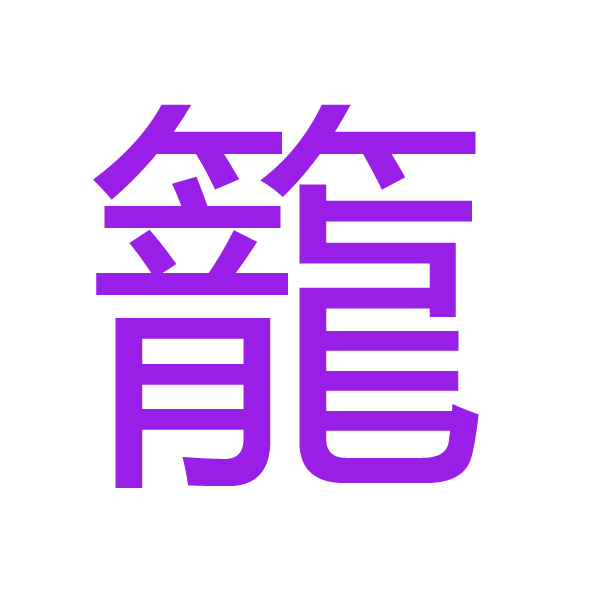
1. Meaning and Usage
The core meaning of the kanji 籠 is "basket," "cage," or "to seclude oneself." It represents a container woven from bamboo or other materials, and by extension, the act of being enclosed or confined within something.
Important Note on Variants:
You have requested 籠, which is the kyūjitai (旧字体), or the traditional form. In modern Japanese, the simplified shinjitai (新字体) 籠 is also common, but an even more simplified form 篭 exists. All share the same core meaning and readings.
Common Readings and Words:
かご (kago): The native Japanese reading for "basket" or "cage."
花籠 (hanakago): Flower basket.
鳥籠 (torikago): Birdcage.
こも (komo): Used in verbs.
籠る (komoru): The basic verb meaning "to seclude oneself," "to stay indoors," "to be filled with (smoke, etc.)."
ろう (rō): The Sino-Japanese reading used in some compound words.
籠城 (rōjō): Holding a castle under siege; a "lockdown." (籠-seclude + 城-castle)
2. Correct Stroke Order
Writing the traditional form 籠 correctly is complex due to the high number of strokes. The kanji is composed of the top radical 竹 (take) and the bottom component 籠.
Total Strokes: 23
Step-by-Step Breakdown:
The character is best broken down into two main parts: the top bamboo radical and the complex bottom part.
Top Radical: 竹 (Take-kanmuri - Bamboo)
Stroke 1 & 2: The left and right parts of the bamboo radical are written. This is typically done in two strokes.
Bottom Component:
Write the top enclosing strokes.
Proceed to write the internal components, which include the 立 and 電-like structures.
Finally, complete the bottom part.
This part is itself a complex character. The general order is:
Detailed Sequence (Simplified):
Begin with the 竹 (bamboo) radical at the top (2 strokes).
Write the main enclosing structure of the bottom component.
Write the internal parts, following top-to-bottom and left-to-right rules.
Complete the character by finishing all internal and enclosing strokes.
Key Stroke Order Rules Applied:
Top to Bottom: The entire character is written from top to bottom.
Left to Right: Applied within sub-components.
Enclose before Close: The outer structure is written before many internal details.
3. Historical Origins and Etymology (The "Story" Behind the Kanji)
The history of 籠 is a fascinating example of an ideographic compound (会意文字 kaii moji) that logically connects its form to its meaning.
Let's break down its components:
竹 (Take): The "bamboo" radical at the top. This is crucial as it identifies the primary material used to make traditional baskets and cages in East Asia - bamboo.
龍 (Ryū): The bottom part contains 龍, which means "dragon." This component serves a dual purpose:
Phonetic: It provided the ancient Chinese sound, which evolved into the Japanese readings ko and rō.
Semantic: It contributes to the meaning of "enclosure" or "coiling."
The Combined Meaning and Evolution:
The character 籠 creates a vivid conceptual image:
"A container woven from bamboo (竹) that is coiled and enclosed like a dragon (龍)."
The connection is ingenious:
Bamboo is the material
The dragon represents the form and action - dragons were often depicted as long, coiling creatures that could envelop and surround things. The intricate, woven structure of a basket resembles this coiling, enclosing nature.
From this concrete image of a physical "basket" or "cage," the meaning naturally expanded to the verbal sense of "to seclude oneself" (籠る komoru). Just as an object is enclosed in a basket, a person can enclose themselves in a room or a place. It can also mean for a space to be "filled with" something, like smoke, as if the smoke is trapped within an invisible basket.
4. Example Sentences
Here are some example sentences showing the different uses of 籠.
As "Basket" (かご):
Romaji: Kago ni kudamono o ireta.
English: I put fruits in the basket.
籠に果物を入れた。
As a Verb "To Seclude Oneself" (こもる):
Romaji: Kare wa ie ni komotte benkyō shita.
English: He secluded himself at home and studied.
彼は家に籠って勉強した。
In a Compound Word (ろう):
Romaji: Sono shiro wa rōjōsen ni sonaeta.
English: The castle prepared for a siege (a defensive battle where one is enclosed in the castle).
その城は籠城戦に備えた。
Summary
Meaning: Basket, cage; to seclude oneself, to be filled with.
Writing: 23 strokes. A highly complex character starting with the 竹 (bamboo) radical, followed by the intricate bottom component containing 龍 (dragon).
Origin: An ideographic compound. It combines 竹 (bamboo), the primary material, with 龍 (dragon), which provides the sound and the conceptual image of something coiled, enclosing, and confining. This perfectly captures both the physical object (a woven basket) and the abstract action (to seclude oneself).