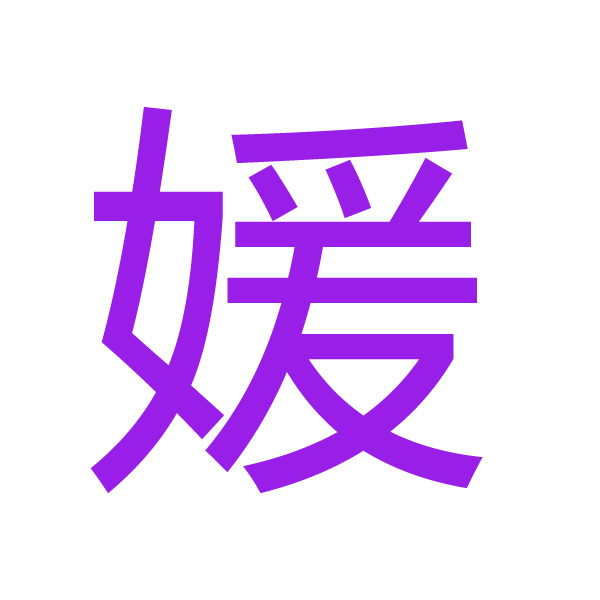
1. Meaning and Usage
The core meaning of the kanji 媛 is "beautiful woman," "princess," or "lovely lady." It carries a classical, elegant, and somewhat formal nuance, often used to describe a woman of noble birth or exceptional beauty.
Common Readings and Words:
ひめ (hime): The native Japanese reading, meaning "princess."
媛 (hime): Can be used as a standalone word for "princess" or "noble lady," though 姫 (hime) is more common for this usage.
えん (en): The Sino-Japanese reading, used in names and compound words.
愛媛県 (Ehime-ken): Ehime Prefecture, located on the island of Shikoku, Japan. This is by far the most common modern usage of this kanji. The name is thought to mean "Lovely Princess."
The primary function of 媛 in modern Japanese is in the name 愛媛県 (Ehime) and in female given names, where it imparts a sense of grace and beauty (e.g., 美媛 (Mihime), 佳媛 (Kahime)).
2. Correct Stroke Order
Writing 媛 correctly is essential for balance. The kanji is composed of the left radical 女 (onna) and the right component 爰 (en).
Total Strokes: 12
Step-by-Step Breakdown:
Left Radical: 女 (Onna - Woman)
Stroke 1: The left-falling stroke (撇).
Stroke 2: The short horizontal stroke (横).
Stroke 3: The final long horizontal stroke (横). Note: The "woman" radical is written completely before moving to the right side.
Right Component: 爰 (En)
Stroke 4: A short left-falling stroke (撇) from the top.
Stroke 5: A short horizontal stroke (横) below it.
Stroke 6: A long horizontal stroke (横) at the bottom.
Stroke 7: A left-falling stroke (撇) from the center.
Stroke 8: A right-dot stroke (捺) for balance.
Stroke 9: The final two strokes form the bottom part. First, a horizontal折 (oritsu).
Key Stroke Order Rules Applied:
Left to Right: The entire left radical 女 is written before the right component 爰.
Top to Bottom: This rule governs the order within the 爰 component.
3. Historical Origins and Etymology (The "Story" Behind the Kanji)
The history of 媛 is a great example of a 形声文字 (keisei moji) or phonetic-ideographic compound.
Let's break down its components:
Semantic Component (Meaning): 女 (Onna)
This radical means "woman." Its presence immediately tells us that the character's meaning is related to a female.
Phonetic Component (Sound & Origin): 爰 (En)
This component's primary role was to provide the ancient Chinese pronunciation, which is the source of the en reading. However, the character 爰 itself is interesting. Its original meaning was "to lead," "to pull," or "thereupon" (a classical conjunction). It was formed from a hand (爪) above, another hand (于) below, and a line in the middle, suggesting the act of handing something over or pulling.
The Combined Meaning and Evolution:
The character 媛 was created to mean a specific type of woman:
"A woman (女) of elegant and graceful bearing."
The connection to the phonetic component 爰 is subtle. The idea of "leading" or "pulling" can be metaphorically extended to mean "to attract" or "to draw the eye." Therefore, a 媛 is a woman whose beauty and grace "draw" attention.
This kanji is classical and appears in ancient Chinese poetry. For instance, it is found in the phrase 淑女 (shukujo) from the Classic of Poetry, describing a virtuous and beautiful maiden. This literary heritage cemented its meaning as a woman of both inner virtue and outer beauty, often of noble status.
4. Example Sentences
Given its specific and somewhat archaic meaning, 媛 is rarely used in everyday sentences outside of proper nouns.
As a Place Name (This is the most common usage):
Romaji: Ehime-ken wa mikan de yūmei da.
English: Ehime Prefecture is famous for its mandarin oranges.
愛媛県はみかんで有名だ。
In a Literary or Poetic Context:
Romaji: Kanojo wa masa ni hime to yobu ni fusawashii.
English: She is truly worthy of being called a beautiful princess/noble lady.
彼女はまさに媛と呼ぶにふさわしい。
In a Historical or Descriptive Context:
Romaji: Sono monogatari ni wa utsukushii hime ga tōjō suru.
English: A beautiful princess appears in that story.
その物語には美しい媛が登場する。
Summary
Meaning: Beautiful woman, princess, lovely lady.
Writing: 12 strokes. Write the left "woman" radical 女 first, then the right phonetic component 爰.
Origin: A phonetic-ideographic compound. It combines 女 (woman) with 爰 (which provided the sound en and connotations of "attracting" or "leading"). It describes a woman of elegant, graceful, and noble bearing, a term with deep roots in classical literature. Its most prominent modern use is in the name of 愛媛県 (Ehime Prefecture).