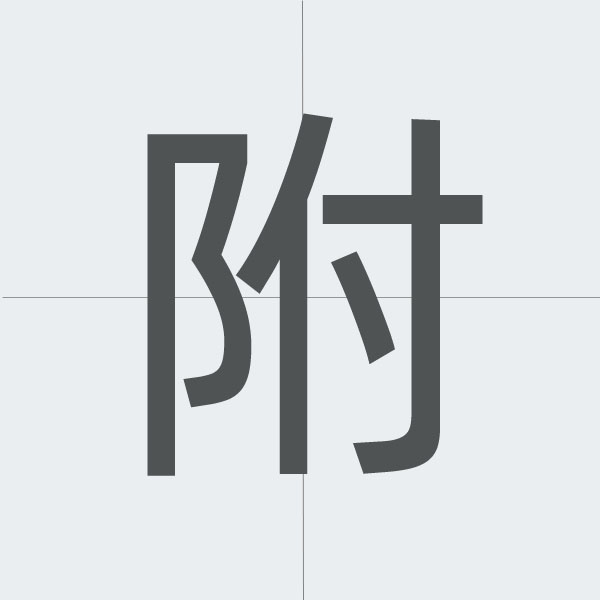
The Kanji: 附 (Fu / Tsu)
The kanji 附 (read as Fu or tsu) primarily means "to attach," "to affix," "to append," or "to accompany." It is composed of the radical 辶 (movement) and the component 付 (to attach), emphasizing the action of moving something to be joined or connected to something else.
It is crucial to note that in modern Japanese, 附 is largely a kyūjitai (old character form) and has been mostly replaced by the simpler 付 in standard usage. You will still encounter 附 in some formal contexts, place names, or set phrases.
Common Words & Example Sentences
1. 附加 (fuka)
Meaning: Addition; attachment; annex. This is equivalent to 付加.
Example Sentence: このサービスには附加料金がかかります。
(Kono sābisu ni wa fuka ryōkin ga kakarimasu.)
"An additional fee is charged for this service."
2. 附属 (fuzoku)
Meaning: Attachment; being affiliated or attached to. This is commonly seen in institutional names and is often written as 附属.
Example Sentence: 彼女は大学の附属高校に通っています。
(Kanojo wa daigaku no fuzoku kōkō ni kayotte imasu.)
"She attends the university's affiliated high school."
3. 寄附 (kifu)
Meaning: A donation or contribution. This is the older form of the more common 寄付.
Example Sentence: 彼は慈善団体に寄附をした。
(Kare wa jizen dantai ni kifu o shita.)
"He made a donation to a charity."
In summary, 附 is a classical kanji representing the concept of attaching or appending. While its use has been largely superseded by 付 in daily life, understanding it is valuable for reading formal documents, historical texts, and specific institutional names like 附属学校 (fuzoku gakkō - affiliated school).