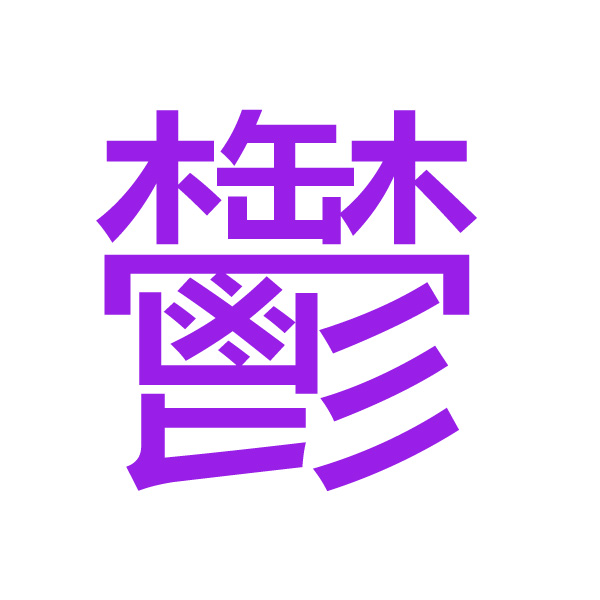
1. Meaning and Usage
The core meaning of the kanji 鬱 is "depression," "gloom," "melancholy," or "to be stifled/blocked." It describes a state of mental oppression, where energy and vitality cannot flow freely.
Common Readings and Words:
うつ (utsu): The main reading.
鬱病 (utsubyō): Depressive illness, clinical depression. (鬱-depression + 病-illness)
鬱々 (utsuutsu): Gloomy, depressed, in low spirits.
憂鬱 (yūutsu): Melancholy, gloominess. (憂-sorrow + 鬱-gloom)
2. Correct Stroke Order
Writing 鬱 is a significant challenge due to its high stroke count and complex structure. The key is to break it down into its main components.
Total Strokes: 29
Step-by-Step Breakdown:
The character can be broken down into three main layers from top to bottom.
Top Layer: 棥 (a complex component)
This part itself contains 林 (woods) and other elements. It is written first, following the top-to-bottom rule.
Middle Layer: 冖 (Wata-kanmuri - Cover)
This radical sits over the next part, creating a sense of being "covered" or "enclosed."
Bottom Layer: A complex combination
This section includes components that resemble 鬯 (an aromatic herb) and 彡 (bristles/hair), all sitting on a base of 冖 (cover) and 凵 (receptacle). The final two strokes are 匕 (spoon/small knife).
Simplified Approach:
Due to its extreme complexity, learners are advised to:
Memorize its overall shape and key components.
Practice writing it by following a stroke order diagram or animation.
Focus on recognizing it rather than producing it from memory, especially initially.
3. Historical Origins and Etymology (The "Story" Behind the Kanji)
The history of 鬱 is a masterclass in creating meaning through layered imagery. It is an ideographic compound (会意文字 kaii moji) that paints a vivid picture of stagnation.
Let's break down its symbolic components:
林 (Hayashi) or 木 (Ki): "Forest," "trees." Represents a dense, overgrown area where movement is difficult.
冖 (Wata-kanmuri): "Cover." Adds a sense of being smothered or enclosed.
鬯 (an aromatic herb): In ancient China, this was a fragrant herb used in rituals. Here, it symbolizes something that should be fragrant and free-flowing but is instead...
凵 (Uke): "Receptacle," "container." ...trapped in a vessel.
彡 (San): "Bristles," "hair," "pattern." Can represent the lingering aroma or the tangled, messy state of the trapped contents.
匕 (Saji): "Spoon," "small knife." Represents a tool, perhaps trying to stir or access what is trapped, but failing to free it.
The Combined Meaning:
The character 鬱 is a powerful pictograph of "stagnation" and "suppression."
It depicts:
"A dense forest (林) covers and encloses (冖) a vessel (凵) containing fragrant herbs (鬯) and other elements, preventing their scent and vitality from spreading, while a tool (匕) is unable to free them."
This intricate scene is a perfect metaphor for depression: a feeling of being trapped, stifled, and unable to express one's inner self or vitality. The life force (the fragrance) is present but cannot flow freely, leading to a state of gloom and oppression.
4. Example Sentences
Given its specific meaning, 鬱 is used in clinical and descriptive contexts related to mental health.
Clinical Context:
Romaji: Kare wa utsubyō de kyūshoku shite iru.
English: He is on leave from work due to depression.
彼は鬱病で休職している。
Descriptive Context:
Romaji: Ame no hi wa kibun ga utsuutsu to suru.
English: I feel gloomy on rainy days.
雨の日は気分が鬱々とする。
General Feeling:
Romaji: Shippai ga atama kara hanarezu utsu na kibun da.
English: I can't get the failure out of my head and am in a depressed mood.
失敗が頭から離れず鬱な気分だ。
Summary
Meaning: Depression, gloom, melancholy, stagnation.
Writing: 29 strokes. A highly complex character best learned by breaking it into top, middle, and bottom layers and studying a stroke order diagram.
Origin: An ideographic compound that is a masterpiece of visual metaphor. It depicts a "dense forest covering a vessel of trapped, fragrant herbs," symbolizing a state where vitality and energy are stifled and cannot flow freely. This powerful image is the source of its meaning related to depression and gloom. It is notoriously one of the most difficult kanji to write, earning it a legendary status among learners.