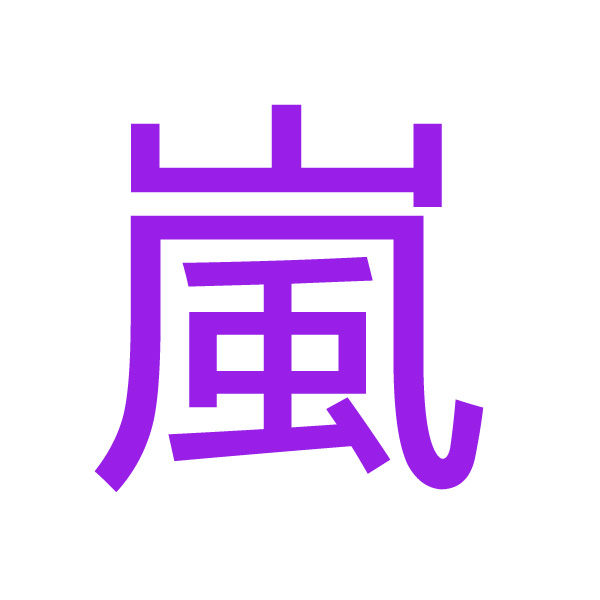
1. Meaning and Usage
The core meaning of the kanji 嵐 is "storm," specifically a violent and powerful one. It can refer to both literal storms (like a thunderstorm or a tempest) and metaphorical storms of emotion or turmoil.
Common Reading and Words:
あらし (arashi): The native Japanese reading.
嵐 (arashi): Storm, tempest.
大嵐 (ōarashi): A great storm, a heavy gale.
While this kanji is most famous globally as the name of the superstar idol group 嵐 (ARASHI), its fundamental meaning in the language remains "storm."
2. Correct Stroke Order
Writing 嵐 correctly is essential for balance. The kanji has a distinctive top-bottom structure, enclosed by the radical ⺹ (yama-kanmuri - mountain).
Total Strokes: 12
Step-by-Step Breakdown:
Top Radical: ⺹ (Yama-kanmuri - Mountain)
Stroke 1: Left vertical stroke (竖).
Stroke 2: Right vertical stroke (竖).
Stroke 3: The horizontal stroke connecting them at the bottom (横). Note: The mountain radical is written completely before moving to the bottom part.
Bottom Component: 風 (Kaze - Wind)
Stroke 4: The left-falling stroke (撇) from the top.
Stroke 5: The horizontal折 (oritsu) that forms the top-right and side.
Stroke 6: The short vertical stroke (竖) inside.
Stroke 7: The dot inside (点).
Stroke 8: The horizontal折 (oritsu) for the bottom part.
Stroke 9: The left dot (点).
Stroke 10: The right dot (点).
Key Stroke Order Rules Applied:
Top to Bottom: The entire top radical ⺹ is written before the bottom component 風.
Enclose before Close: The outer structure of the 風 component is established before the inner details are filled in.
3. Historical Origins and Etymology (The "Story" Behind the Kanji)
The history of 嵐 is a brilliant and intuitive example of an ideographic compound (会意文字 kaii moji), where the meaning is derived directly from its components.
The kanji 嵐 is composed of two powerful natural elements:
山 (Yama): The top part is the "mountain" radical (⺹). Mountains are known for channeling and intensifying weather patterns.
風 (Kaze): The bottom part is the character for "wind."
The Combined Meaning:
The meaning of 嵐 is created by the powerful combination of these two elements:
"A wind (風) so fierce that it seems to be born from or rage through the mountains (山)."
This is a perfect description of a storm. In Japan's mountainous terrain, storms are often most violent in the highlands, with winds howling through the valleys and over the peaks. The character visually captures this scene: the mountains being assaulted by a powerful, swirling wind below.
It doesn't just mean "rain"; it specifically conjures an image of wild, untamed, and powerful natural forces at work.
4. Example Sentences
Here are some example sentences showing the use of 嵐.
Literal Meaning (Storm):
Romaji: Sakuya wa hidoi arashi datta.
English: There was a terrible storm last night.
昨夜はひどい嵐だった。
Metaphorical Meaning (Turmoil):
Romaji: Kare no kokoro wa gekijō no arashi datta.
English: His heart was a storm of passion. (His heart was in turmoil.)
彼の心は激情の嵐だった。
Referring to the Famous Group:
Romaji: Arashi no konsāto ni ikitai.
English: I want to go to an ARASHI concert.
嵐のコンサートに行きたい。
Summary
Meaning: Storm, tempest.
Writing: 12 strokes. Write the top "mountain" radical ⺹ first, then the bottom "wind" component 風.
Origin: An ideographic compound. It combines 山 (mountain) and 風 (wind) to create the vivid image of a "fierce wind raging in the mountains," which is the essence of a powerful storm. This character is a masterclass in creating meaning through simple, logical combinations of natural elements.