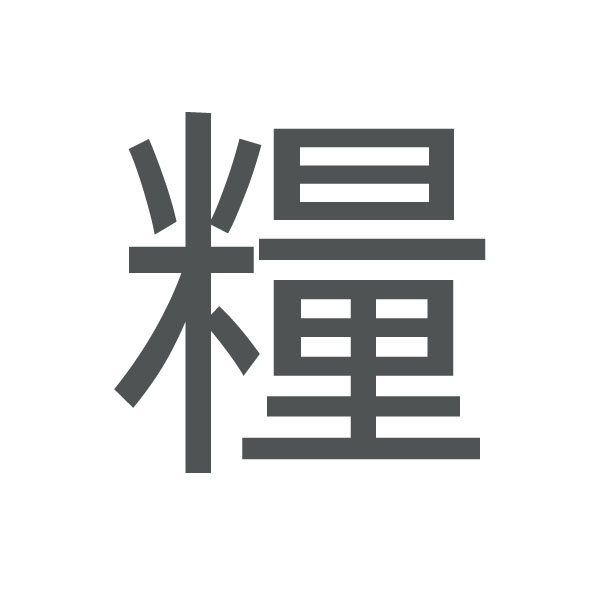
1. Kanji Breakdown: 糧
This kanji represents a profound concept of sustenance, both physical and spiritual.
Meaning: Food, provisions, nourishment; sustenance (for the mind or soul).
Reading:
Onyomi (Sino-Japanese reading): リョウ (ryou), ロウ (rou)
Kunyomi (Native Japanese reading): かて (kate)
The kanji is a phono-semantic compound (形声文字). It consists of two parts:
Left (米): This means "rice," representing the most basic and essential food staple.
Right (量): This means "quantity," "amount," or "to measure."
Thus, the character literally means "a measured quantity of rice." This evolved to mean "provisions" or "food supplies" for a journey. Because food is essential for sustaining life, the meaning further expanded to include anything that provides nourishment or support, even in an abstract sense for the spirit or mind.
2. Stroke Order and Writing
Learning the correct stroke order is crucial for balanced and beautiful kanji. "糧" has 18 strokes.
Here is the stroke order diagram and explanation:
Total Strokes: 18
Start with the left radical "米" (rice radical):
Then, write the right part "量":
Key Writing Tips:
Write from left to right, top to bottom.
The left radical "米" is narrow. Pay attention to the cross-shaped strokes and the final two dots.
The right part "量" is complex and wide. Break it down into the top "日" and the bottom "里".
Due to its high stroke count, careful spacing is key to keeping the character legible.
3. Vocabulary and Example Sentences
Here are some common words using "糧" and how to use them in sentences.
Vocabulary
食糧 (しょくりょう, shokuryou)
Meaning: Food, food supplies, provisions.
Example: 災害に備えて食糧を備蓄する。
Romaji: Saigai ni sonaete shokuryou o bichiku suru.
English: We stockpile food supplies in preparation for disasters.
糧 (かて, kate)
Meaning: Nourishment, food (both literal and spiritual); something that gives strength.
Example: この経験は将来の糧となるだろう。
Romaji: Kono keiken wa shōrai no kate to naru darou.
English: This experience will become sustenance for my future.
心の糧 (こころのかて, kokoro no kate)
Meaning: Spiritual nourishment, food for the soul.
Example: 音楽は私の心の糧だ。
Romaji: Ongaku wa watashi no kokoro no kate da.
English: Music is food for my soul.
携行糧食 (けいこうりょうしょく, keikō ryōshoku)
Meaning: Emergency rations, carried provisions.
例文: 登山には携行糧食が欠かせない。
Romaji: Tozan ni wa keikō ryōshoku ga kakasenai.
English: Emergency rations are essential for mountain climbing.
糧食 (りょうしょく, ryōshoku)
Meaning: Provisions, foodstuffs.
Example: 糧食が尽きかけている。
Romaji: Ryōshoku ga tsukikakete iru.
English: The provisions are running low.
Summary
Kanji: 糧
Core Meaning: Food, Provisions; Nourishment, Sustenance (both physical and spiritual).
Readings: On'yomi リョウ (ryou), Kun'yomi かて (kate)
Stroke Order: 18 strokes. Remember it's composed of 米 (rice) and 量 (quantity). Practice writing it step-by-step to master its form.
This kanji is essential for discussing survival, preparation, and personal growth. Its ability to represent both physical food and spiritual sustenance makes it a deeply meaningful character. By mastering its stroke order and vocabulary, you will be able to correctly write and use this profound character.