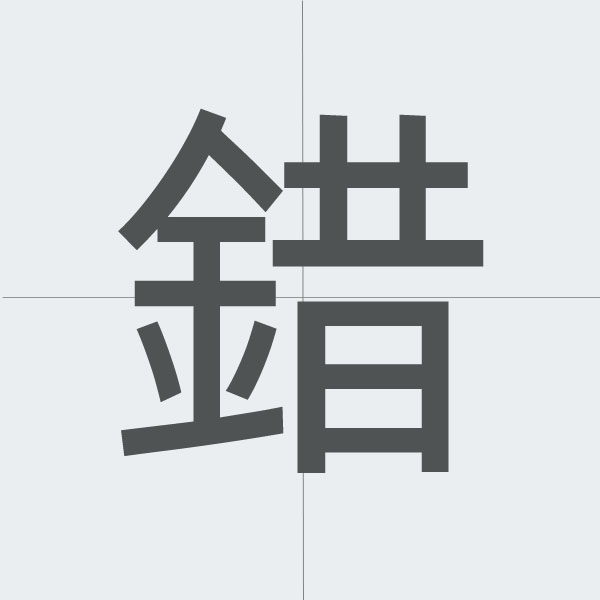
The Kanji: 錯 (Saku)
The kanji 錯 (read as saku) primarily means "confusion," "mix-up," or "disorder." It is composed of the radical 金 (metal/gold) and the component 昔 (past). One interpretation suggests the idea of metals being intricately inlaid or fused together, leading to a complex, intermingled, and potentially confused state.
Common Words & Example Sentences
1. 錯誤 (sakugo)
Meaning: Error; mistake; misconception.
Example Sentence: それは認識錯誤です。
(Sore wa ninshiki sakugo desu.)
"That is a misperception (a mistake in recognition)."
2. 錯覚 (sakkaku)
Meaning: Optical illusion; hallucination; false perception.
Example Sentence: それはただの錯覚でした。
(Sore wa tada no sakkaku deshita.)
"It was just an illusion."
3. 錯乱 (sakuran)
Meaning: Mental confusion; derangement; chaos.
Example Sentence: 彼は悲しみのあまり精神が錯乱した。
(Kare wa kanashimi no amari seishin ga sakuran shita.)
"He suffered from mental confusion due to grief."
4. 交錯 (kōsaku)
Meaning: Interweaving; mingling; crossing (e.g., of emotions or gazes).
Example Sentence: 複雑な感情が交錯する。
(Fukuzatsu na kanjō ga kōsaku suru.)
"Complex emotions interweave."
In summary, 錯 is a kanji that represents states of confusion and disorder, ranging from visual misperceptions (錯覚) and mental chaos (錯乱) to simple errors (錯誤) and the intermingling of different elements (交錯).