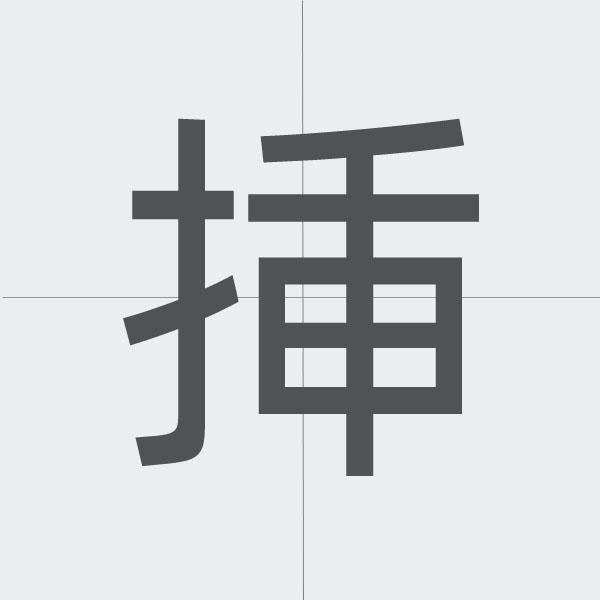
The Kanji: 挿 (Sō / Sa)
The kanji 挿 (read as Sō or sa) carries the core meaning of "to insert," "to put in," or "to plug in." It is composed of the hand radical (扌) on the left, indicating a hand action, combined with the right side which historically relates to a planting or placing action. This structure clearly depicts the physical act of inserting one thing into another.
Common Words & Example Sentences
1. 挿す (sasu)
Meaning: To insert; to stick into; to plug in.
Example Sentence: コンセントにプラグを挿してください。
(Konsento puragu o sashite kudasai.)
"Please plug the cord into the outlet."
2. 挿入 (sōnyū)
Meaning: Insertion (can be physical or abstract, like inserting text or a scene).
Example Sentence: 文書に図を挿入しました。
(Bunsho ni zu o sōnyū shimashita.)
"I inserted a diagram into the document."
3. 挿し木 (sashiki)
Meaning: Plant cutting; propagation by cutting.
Example Sentence: バラの挿し木に成功しました。
(Bara no sashiki ni seikō shimashita.)
"I successfully propagated the rose from a cutting."
In summary, 挿 is a practical kanji that specifically describes the action of insertion. Its usage ranges from everyday tasks like plugging in a device (挿す) to technical contexts like editing documents (挿入) and gardening techniques (挿し木).