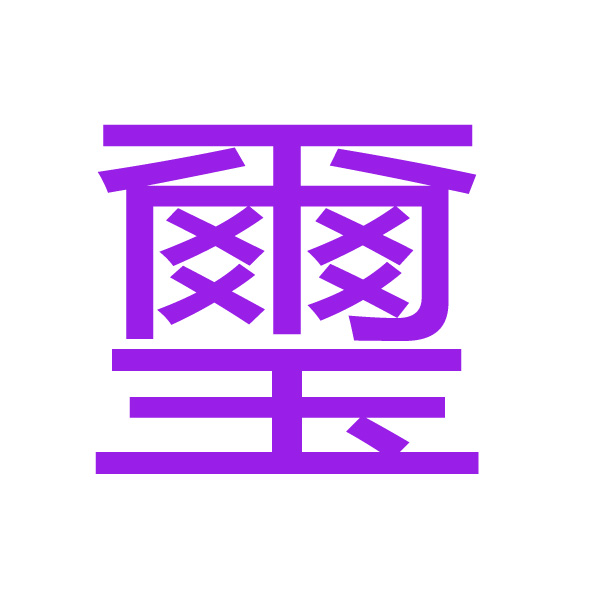
1. Meaning and Usage
The core meaning of the kanji 璽 is "imperial seal" or "royal stamp." It refers specifically to the seal used by an emperor or monarch to authenticate official documents and proclamations.
In Japan, this character holds immense cultural and political significance:
御璽 (Gyoji): The Imperial Seal of Japan, used by the Emperor to certify state documents and laws.
国璽 (Kokuji): The Great Seal of Japan (National Seal), used by the government to certify important treaties and state documents.
Common Reading:
じ (ji): The Sino-Japanese reading, used almost exclusively in the formal terms mentioned above.
2. Correct Stroke Order
Writing 璽 correctly requires patience and precision, as it is one of the more complex kanji. It is composed of multiple layered components.
Total Strokes: 19
Step-by-Step Breakdown:
The character can be broken down into a top part and a bottom part.
Top Part:
This section is composed of several elements stacked vertically. The order generally follows top-to-bottom, writing elements like the "jade" radical and other components one after the other.
Bottom Part: 玉 (Tama - Jade)
Horizontal strokes first, then the central vertical, and finally the dot.
Stroke 1-4: The character 玉 is written in its standard order:
Detailed Sequence (Simplified):
Begin with the topmost strokes (the horizontal and dot elements).
Write the central vertical column of strokes.
Complete the surrounding strokes of the upper structure.
Finally, write the bottom component 玉 (jade) in its standard stroke order.
Key Stroke Order Rules Applied:
Top to Bottom: The entire upper section is completed before the lower 玉 radical.
Left to Right: Applied within sub-components.
Horizontal before Vertical: A fundamental rule followed throughout.
3. Historical Origins and Etymology (The "Story" Behind the Kanji)
The history of 璽 is deeply rooted in ancient Chinese culture and power structures. It is an ideographic compound (会意文字 kaii moji).
Let's break down its components:
爾 (ji): The top part of the character is an ancient form of 爾, which meant "you" (formal) but was primarily used here for its phonetic value to represent the sound "ji."
玉 (Gyoku - Jade): This is the semantic component that provides the core meaning. Jade was the most precious substance in ancient East Asia, symbolizing purity, virtue, and supreme authority.
The Combined Meaning and Evolution:
The character 璽 was created to mean:
"The jade object of supreme authority."
In ancient China, seals were crucial symbols of power and identity. Initially, the words for "seal" were used broadly. However, the First Emperor of Qin, Qin Shi Huang, decreed that the character 璽 could only be used for the seals of the Emperor himself. Seals for officials and commoners had to use other characters like 印.
This decree cemented 璽 as the ultimate symbol of imperial legitimacy. The choice of the 玉 (jade) radical was intentional, as imperial seals were often carved from the finest jade, distinguishing them from the bronze or wood used for lower-ranking seals.
When this system was adopted in Japan, the profound cultural weight of the character came with it. The 御璽 (Imperial Seal) and 国璽 (National Seal) are the physical embodiments of state power, and the character 璽 itself has become a symbol of the Emperor's constitutional role and the sovereignty of the nation.
4. Example Sentences
Given its highly specific and formal nature, 璽 is almost never used in everyday sentences. Its usage is confined to official, historical, or news contexts.
In an Official/News Context:
Romaji: Atarashii hōritsu ga gyoji o itadaita.
English: The new law received the Imperial Seal. (Meaning it was formally certified by the Emperor).
新しい法律が御璽をいただいた。
In a Historical Context:
Romaji: Sono chokurei ni wa ji ga osarete ita.
English: The imperial decree had the imperial seal stamped on it.
その勅令には璽が押されていた。
Defining the Term:
Romaji: Ji to wa tennō no inshō de aru.
English: The "Ji" (Imperial Seal) is the official seal of the Emperor.
璽とは天皇の印章である。
Summary
Meaning: Imperial Seal, Royal Stamp.
Writing: 19 strokes. A highly complex character where the top phonetic component is written first, followed by the bottom semantic component 玉 (jade).
Origin: An ideographic compound created in ancient China. It combines a phonetic element (爾) with the semantic radical 玉 (jade) to mean "the jade seal." Its use was restricted exclusively to the emperor's seal, a tradition that continued in Japan, making it a powerful symbol of state authority and legitimacy.