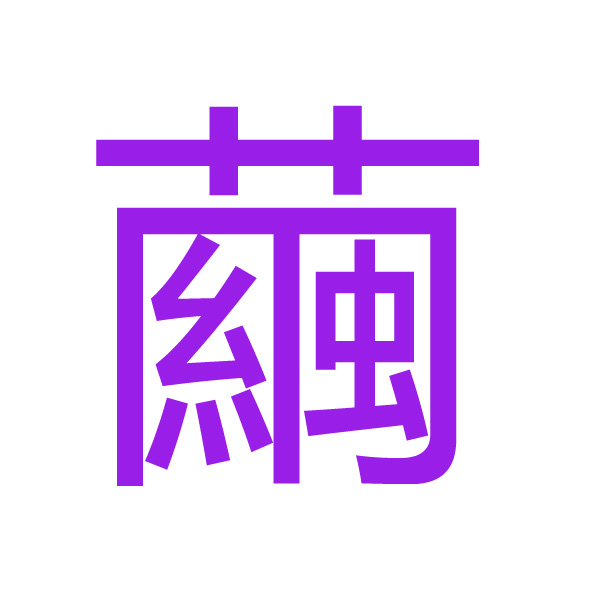
1. Meaning and Usage
The core meaning of the kanji 繭 is "cocoon," specifically the silkworm cocoon. It represents the protective shell spun by silkworm larvae, which is the crucial raw material for producing silk.
Common Readings and Words:
まゆ (mayu): The native Japanese reading for "cocoon."
蚕の繭 (kaiko no mayu): Silkworm cocoon.
けん (ken): The Sino-Japanese reading used in more technical or compound words.
繭糸 (kenshi): Cocoon thread, raw silk filament.
2. Correct Stroke Order
Writing 繭 correctly requires careful attention as it is a complex character with many strokes. It is composed of the upper component 艹 (kusa-kanmuri - grass) and the main body 絸.
Total Strokes: 18
Step-by-Step Breakdown:
The character can be broken down into two main parts: the grass radical on top and a complex body below.
Top Radical: 艹 (Kusa-kanmuri - Grass)
Stroke 1: Left vertical and horizontal hook.
Stroke 2: Right vertical and horizontal hook. The grass radical is typically written with these two strokes.
Main Body:
Stroke 3-5: The 糸 (ito - thread) component on the left side is written.
Stroke 6-9: The central part, which includes the 冂 structure and internal strokes, is completed.
Stroke 10-18: The right side containing 虫 (mushi - insect) and additional enclosing strokes are written.
Detailed Sequence:
Write the grass radical 艹 (2 strokes)
Complete the left 糸 thread component (3 strokes)
Write the central enclosing structure and internal strokes
Finish with the right 虫 insect component and final strokes
Key Stroke Order Rules Applied:
Top to Bottom: The entire character is written from top to bottom
Left to Right: Applied within sub-components
Enclose before Close: The central structure follows this principle
3. Historical Origins and Etymology (The "Story" Behind the Kanji)
The history of 繭 is a perfect example of an ideographic compound (会意文字 kaii moji) that vividly depicts its meaning through its components.
Let's break down its elements:
艹 (Kusa-kanmuri): The "grass" radical at the top. This indicates that the character is related to something found in nature, often among plants or grass.
糸 (Ito): The "thread" or "silk" radical on the left. This is crucial as it identifies the material - silk threads.
虫 (Mushi): The "insect" component on the right. This identifies the creator of the cocoon - the silkworm insect.
The Enclosing Structure: The framework that surrounds the insect represents the cocoon itself - the protective casing that envelops the silkworm.
The Combined Meaning:
The character 繭 creates a perfect visual and conceptual representation:
"An insect (虫) surrounded by silk threads (糸) in a natural setting (艹)."
This is essentially a pictogram of a silkworm cocoon in its natural environment. The character shows:
What it's made of (silk threads)
What creates it (an insect)
What it is (a protective enclosure)
Where it's found (in nature, among plants)
The genius of this kanji is that it doesn't just mean "cocoon" abstractly - it actually shows you what a cocoon is through its composition.
4. Example Sentences
Here are some example sentences showing the use of 繭.
Basic Meaning:
Romaji: Kaiko ga mayu o tsukutta.
English: The silkworm made a cocoon.
蚕が繭を作った。
Descriptive Context:
Romaji: Shiroi mayu kara utsukushii kinu ito ga toreru.
English: Beautiful silk thread can be obtained from white cocoons.
白い繭から美しい絹糸が取れる。
Cultural Context:
Romaji: Kono chihō de wa mayu o tsukatta dentō kōgei ga aru.
English: There is traditional craftsmanship using cocoons in this region.
この地方では繭を使った伝統工芸がある。
Summary
Meaning: Cocoon (particularly silkworm cocoon).
Writing: 18 strokes. A complex character written from top to bottom, starting with the grass radical, then the thread component, and finally the enclosed insect.
Origin: An ideographic compound that functions as a detailed pictogram. It combines grass (艹) for the natural setting, thread (糸) for the material, insect (虫) for the creator, and an enclosing structure for the cocoon itself, creating a complete visual representation of a silkworm cocoon in its natural environment.