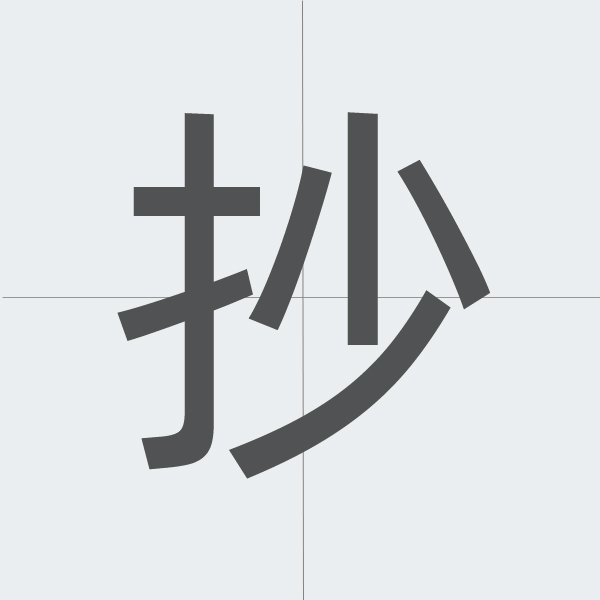
Kanji: 抄 (Shō) - Extract & Copy
The Japanese kanji 抄 (shō) primarily means "extract," "summary," or "to copy." It represents the act of selecting essential parts or creating a transcribed copy of something.
Stroke Order & Writing:
Start with the left radical 扌(hand): write the horizontal stroke, vertical hook, and then the rising stroke.
Then write the right component 少: vertical stroke, left and right dots, finishing with the long left-slanting stroke.
Common Vocabulary & Usage:
抄録 (shōroku): Summary, abstract. "論文の抄録を読む。" (Ronbun no shōroku o yomu.) - "Read the abstract of the paper."
抄写 (shōsha): Copying, transcription. "古文書を抄写する。" (Komonjo o shōsha suru.) - "To transcribe an old document."
抄本 (shōhon): Manuscript, copied book. "重要文化財の抄本。" (Jūyō bunkazai no shōhon.) - "A manuscript copy of an important cultural property."
This kanji is essential for academic, literary, and archival contexts, describing the process of condensing information or reproducing texts.