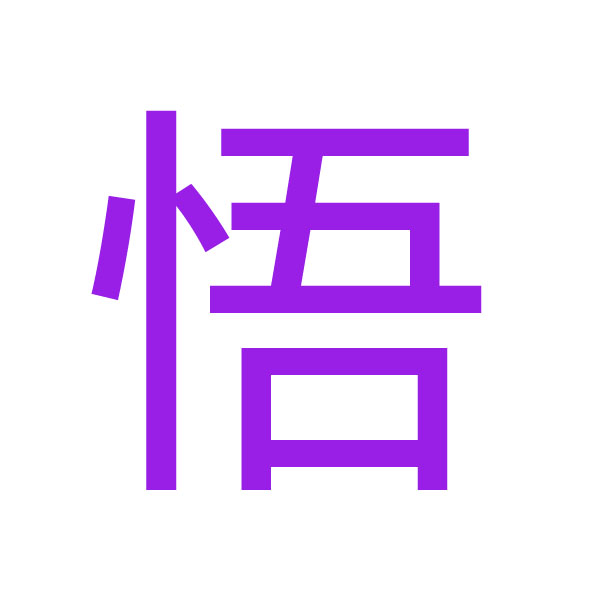
1. Kanji Breakdown: 悟
This kanji represents a profound concept of spiritual awakening and understanding, deeply rooted in Buddhist philosophy.
Meaning: Enlightenment, spiritual awakening; to perceive, to realize, to become aware.
Reading:
Onyomi (Sino-Japanese reading): ゴ (go)
Kunyomi (Native Japanese reading): さと(る) (sato(ru))
The kanji is a phono-semantic compound (形声文字). It consists of two parts:
Left (忄): This is the "heart" or "mind" radical (りっしんべん), representing one's inner being, consciousness, and spirit.
Right (吾): This means "I," "me," or "myself," and it also provides the sound "go."
Thus, the character embodies the meaning of "the mind/heart realizing the self" or "awakening of the self." It is the moment of profound understanding where one perceives the true nature of reality and the self.
2. Stroke Order and Writing
Learning the correct stroke order is crucial for balanced and beautiful kanji. "悟" has 10 strokes.
Here is the stroke order diagram and explanation:
Total Strokes: 10
Start with the left radical "忄" (heart radical):
Then, write the right part "吾":
Key Writing Tips:
Write from left to right, top to bottom.
The left radical "忄" is narrow. Remember it is written as two dots and a vertical stroke.
The right part "吾" is wider. Pay attention to the order of the five horizontal strokes.
The overall structure should be balanced, with the "吾" part providing a solid base.
3. Vocabulary and Example Sentences
Here are some common words using "悟" and how to use them in sentences.
Vocabulary
悟る (さとる, satoru)
Meaning: To perceive, to realize, to attain enlightenment.
Example: ついに彼は自分が間違っていたことを悟った。
Romaji: Tsui ni kare wa jibun ga machigatte ita koto o satotta.
English: He finally realized that he was wrong.
覚悟 (かくご, kakugo)
Meaning: Readiness, preparedness, resolution (often for something difficult); mental preparation.
Example: 最悪の事態への覚悟はできている。
Romaji: Saiaku no jitai e no kakugo wa dekite iru.
English: I am prepared for the worst-case scenario.
悟り (さとり, satori)
Meaning: Enlightenment, spiritual awakening (the noun form). This is a central concept in Zen Buddhism.
Example: 座禅を通して悟りを開く。
Romaji: Zazen o tōshite satori o hiraku.
English: To achieve enlightenment through Zen meditation.
悟性 (ごせい, gosei)
Meaning: Comprehension, understanding, intellect.
Example: 彼は悟性が高い。
Romaji: Kare wa gosei ga takai.
English: He has a high level of comprehension.
大悟 (たいご, taigo)
Meaning: Great enlightenment, supreme awakening.
Example: 彼は人生の真理を大悟した。
Romaji: Kare wa jinsei no shinri o taigo shita.
English: He attained great enlightenment regarding the truth of life.
Summary
Kanji: 悟
Core Meaning: Enlightenment, Awakening, Realization.
Readings: On'yomi ゴ (go), Kun'yomi さとる (satoru)
Stroke Order: 10 strokes. Remember it's composed of 忄 (left - heart/mind) and 吾 (right - I/self). Practice writing it step-by-step to master its form.
This kanji is essential for understanding philosophical and spiritual concepts in Japanese. By mastering its stroke order and vocabulary, you will be able to grasp and express deep ideas about awareness and enlightenment.