Kanji Analysis: 瘍 (YŌ)
Meaning:
The core and primary meaning of the kanji 瘍 is "sore," "ulcer," or "cancer" (in medical terminology). It refers to a lesion, a wound that is festering or not healing, or a pathological growth. It is a purely medical and pathological term.
Composition:
Radical: 疒 (やまいだれ, yamaidare) - The "sickness" or "disease" radical. This immediately places the character's meaning in the realm of illness and pathology.
Phonetic Component: 昜 (YŌ) - This component provides the sound ("yō").
The combination creates a direct and unambiguous image: a sickness or disease manifesting on the body.
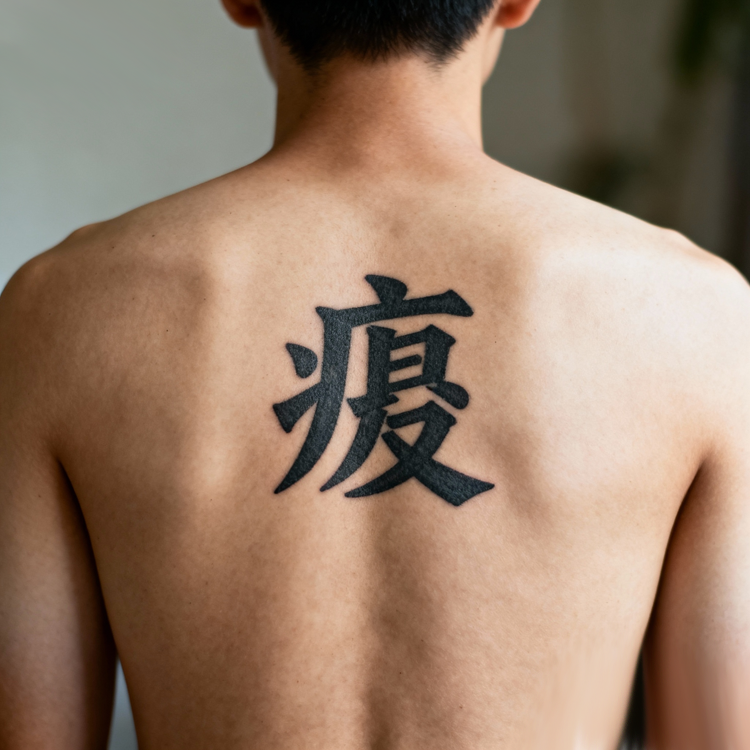
Common Usages and Examples
This kanji is used almost exclusively in medical terminology.
Common Compound Words:
胃潰瘍 (ikaiyō): Stomach ulcer.
潰瘍 (kaiyō): Ulcer.
腫瘍 (shuyō): Tumor, neoplasm.
がん (gan): The common word for "cancer," which can be written with the kanji 癌, sharing the same "sickness" radical and a similarly negative connotation.
Example Sentences:
ストレスが原因で胃潰瘍になった。
(Sutoresu ga gen'in de ikaiyō ni natta.)
"I developed a stomach ulcer due to stress."その腫瘍は良性だった。
(Sono shuyō wa ryōsei datta.)
"The tumor was benign."口内炎は一種の潰瘍である。
(Kōnaien wa isshu no kaiyō de aru.)
"A canker sore is a type of ulcer."
"瘍" as a Tattoo: Meanings and Cautions
As a tattoo, "瘍" is one of the most high-risk and unequivocally terrible choices possible. Its meaning is starkly negative, associated with disease, decay, and suffering.
Potential Personal Meanings (The Reinterpreted Intent):
In an extremely theoretical and niche scenario, someone might try to assign it a meaning related to overcoming illness:
A Mark of Survival: For someone who has survived a serious illness like cancer or a chronic ulcer, it could be intended as a stark symbol of their battle and survival.
However, this intention is almost certain to be completely misunderstood and is not recommended under any circumstances.
Strong Cautions and Negative Connotations (Extremely Important!):
Overwhelmingly Negative Medical Connotation: This is the most critical point. To any Japanese person, this character means "ULCER," "SORE," and "DISEASE." It is a symbol of sickness and pathology. A tattoo would be perceived as shocking, deeply disturbing, morbid, and culturally ignorant.
Invitation of Bad Luck and Negative Energy: In many cultures, including Japan, displaying symbols of disease is believed to attract that very misfortune. Permanently marking your body with a character for "ulcer" could be seen as inviting sickness and bad luck.
Severe Social Ostracism and Misunderstanding: This tattoo would cause fear, disgust, and alienation. People would likely assume you have a serious, visible illness or a profound psychological issue. It would be socially catastrophic.
Association with Death and Decay: The character is directly linked to conditions that can be painful, debilitating, and fatal. It is a symbol of physical decay.
The "Survivor" Interpretation is Not Viable: The positive reinterpretation is impossibly fragile. No one will assume you are a survivor; they will assume you are currently sick or have a disturbing fixation.
Final Verdict and Recommendation
Under absolutely no circumstances should you get a tattoo of the kanji "瘍".
The risks of causing severe offense, being perceived as mentally unwell, and inviting negative social and spiritual consequences are absolute. This character embodies suffering and should never be used as body art.
If you are seeking a tattoo to represent "survival," "healing," or "overcoming illness," here are powerful and positive alternatives:
For Healing and Recovery, use 治 (chi - to heal) or 癒 (iyasu - to heal, to cure).
For Strength and Survival, use 強 (tsuyoi - strong) or 生 (sei - life, to live).
For A New Beginning, use 新生 (shinsei - new life) or 再生 (saisei - rebirth, regeneration).
In summary:
While "瘍" is an important character in medical science, as a tattoo, it is an exceptionally poor, offensive, and ill-omened choice. It demonstrates a profound misunderstanding of cultural sensibilities and the nature of kanji as personal symbols. Choosing any other character is imperative. This character should remain in medical textbooks and hospitals, not on human skin.